
TCL Chinese Theatre: How Hollywood’s Handprints Became a Landmark |
The movie palace opened in 1927, but the wet cement outside became one of Hollywood’s most enduring attractions. |
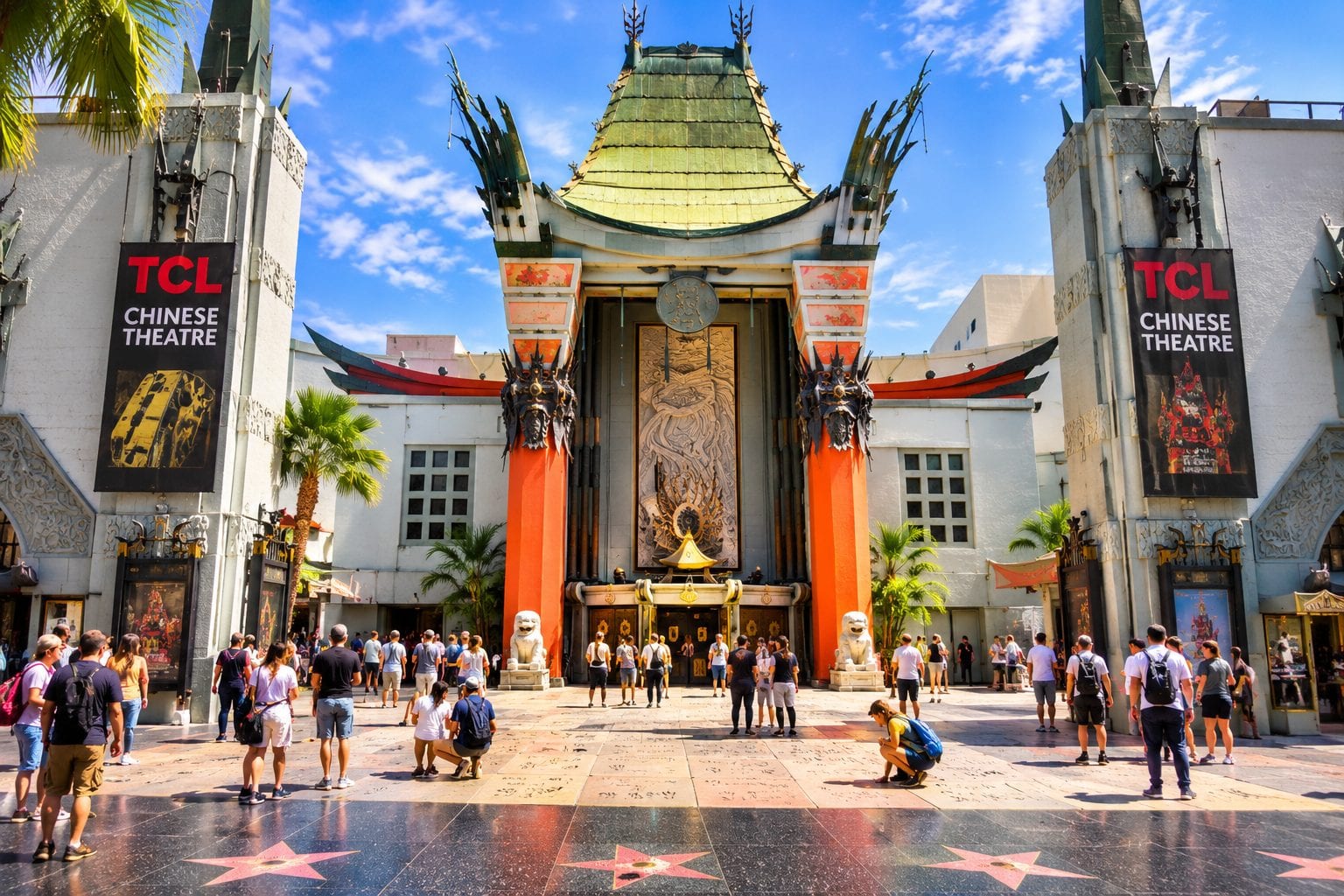
Hollywood has plenty of places where people look up, but outside the Chinese Theatre, some of the most interesting history is under your feet. The theater that now carries the TCL name opened on Hollywood Boulevard in 1927, created by showman Sid Grauman as a movie palace meant to feel spectacular before the audience even reached its seat. Its pagoda-like roofline, red columns, ceremonial details and dramatic forecourt made the building instantly recognizable. The Los Angeles Conservancy identifies the 1927 theater as a Hollywood landmark designed by Meyer & Holler. But the feature that turned it into a ritual stop for generations of visitors came from something far simpler: wet cement. A Movie Palace Built to Be RememberedWhen Did the Chinese Theatre Open?The theater opened in May 1927 with Cecil B. DeMille’s The King of Kings. Grauman had already helped establish the Egyptian Theatre nearby, but the new Chinese Theatre pushed the idea of the Hollywood premiere into something even more theatrical. There is a family resemblance in the boulevard’s history, too. Developer Charles E. Toberman helped bring the Chinese, Egyptian and El Capitan theatres to Hollywood. Across the boulevard, El Capitan had opened in 1926 as a live-theater venue; the Chinese followed in 1927 as a movie palace. Their different beginnings reveal a neighborhood building an audience for both stage and screen. The architecture was designed to make arriving part of the experience. Long before giant multiplex lobbies and branded fan events, this building treated the sidewalk, courtyard and entrance as part of the show. What Was the Chinese Theatre Originally Called?It opened as Grauman’s Chinese Theatre, named for Sid Grauman. The theater later became known as Mann’s Chinese Theatre before receiving its current TCL Chinese Theatre name through a naming-rights agreement. The names changed; the building and its forecourt remained the recognizable Hollywood landmark. The opening itself was an elaborate production. On May 18, 1927, audiences came to see Cecil B. DeMille’s silent biblical epic The King of Kings, but the evening offered much more than a screening. Grauman presented a large stage prologue, complete with performers, elaborate scenery and live orchestral music. In an era before synchronized dialogue became standard, the theater made a movie night feel like a major live event. The building’s spectacle was carefully planned. Raymond Kennedy, working with the Meyer & Holler firm, designed the dramatic pagoda-inspired roof and towering columns. Chinese American artists contributed important decorative elements: filmmaker Moon Quan collaborated with artisans on statues, while actor and artist Keye Luke painted lobby murals. These contributions are part of the building’s history, alongside its theatrical interpretation of Chinese design. Why Was the Chinese Theatre So Different From Other Movie Palaces?Grauman was selling an experience, not just a seat. The forecourt created a dramatic pause between the noise of Hollywood Boulevard and the theater doors. The towering roofline, sculptural ornament and richly decorated interior gave moviegoers a sense that they were entering a world apart. Even before the first frame appeared, the building had already begun telling a story. Its design also reflected Hollywood’s appetite for theatrical fantasy. Architectural historians describe the style as Exotic Revival: an imaginative American interpretation rather than a faithful reproduction of a Chinese temple. Recognizing that distinction makes the building more interesting, not less. It reveals the era’s ideas about spectacle while leaving room to appreciate the work of the Chinese American artists and craftspeople who contributed to its details. How Wet Cement Became Hollywood HistoryWho Started the Handprint Tradition?The exact origin story has been retold in several versions, but the tradition took shape during the theater’s construction and opening period, when stars began leaving handprints, footprints and signatures in cement. |
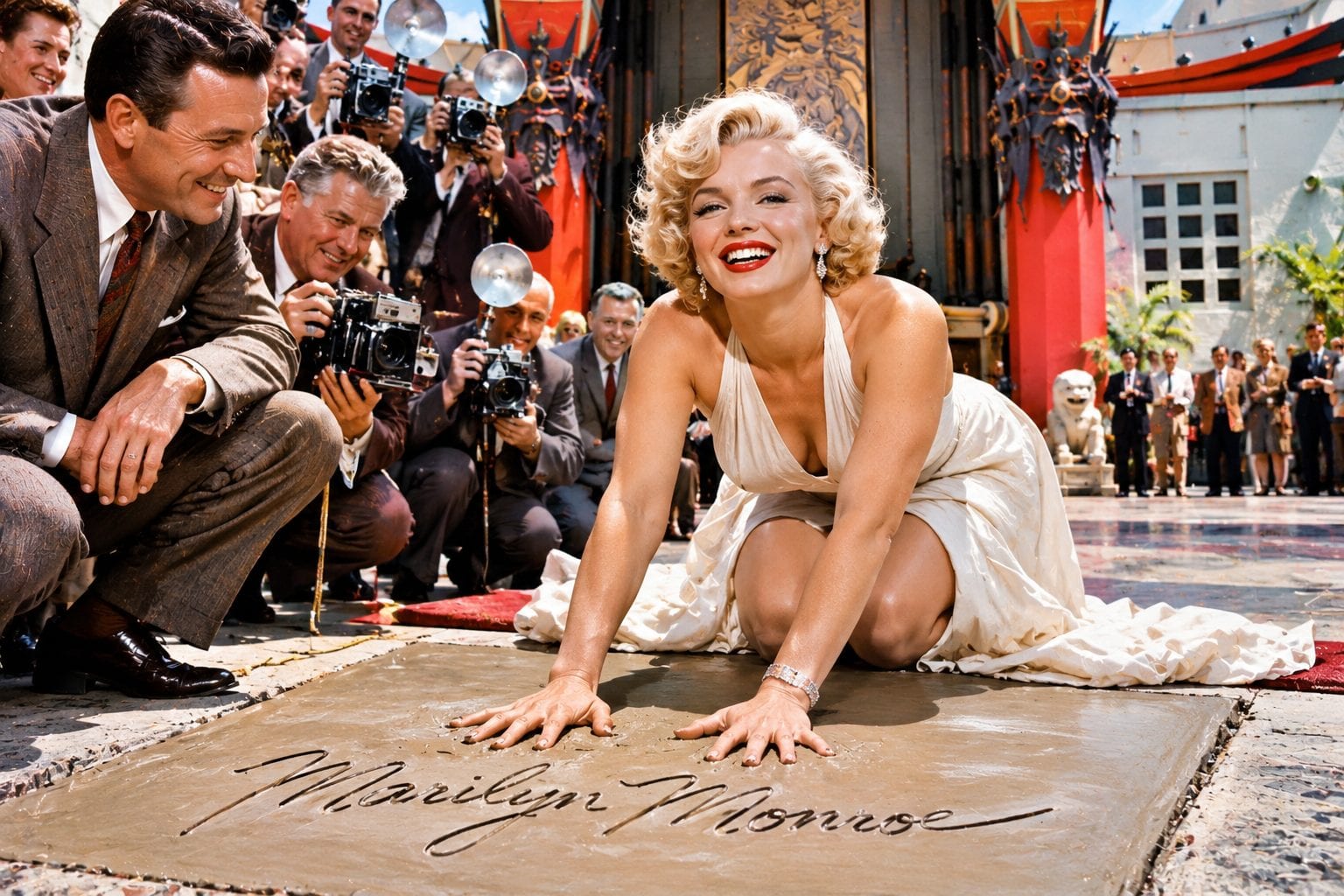 AI-generated editorial recreation of a classic Hollywood cement-imprint ceremony; not a historical photograph. |
Mary Pickford and Douglas Fairbanks were among the earliest participants, and the practice quickly became part of the theater’s identity. What might have been a promotional stunt became something much more durable: a physical record of changing generations of performers. That is what makes the forecourt different from an ordinary celebrity display. The marks are not simply names on plaques. They preserve scale, handwriting and personality. Some stars added jokes, drawings or messages. Some stood barefoot. Others pressed props into the cement. One popular account says silent-film actress Norma Talmadge accidentally stepped into wet cement during construction and inspired Grauman to turn a mishap into a Hollywood tradition. It is a memorable story, but accounts differ, so it is best understood as part of the theater’s folklore rather than a settled fact. What is documented is that Mary Pickford and Douglas Fairbanks made early official impressions on April 30, 1927, shortly before the theater opened. Over time, the imprints became tiny portraits of personality. Marilyn Monroe and Jane Russell took part in a ceremony associated with Gentlemen Prefer Blondes; Monroe’s cement impression even incorporated an earring. Other honorees used distinctive footwear, gestures or inscriptions. The details invite visitors to look closely rather than simply scan a list of famous names. A Sidewalk That Became an ArchiveAre the Handprints the Same as the Walk of Fame?No. The Hollywood Walk of Fame and the Chinese Theatre forecourt are separate Hollywood traditions. Walk of Fame stars stretch along public sidewalks, while the handprints and footprints belong to the theater’s private forecourt and are tied to ceremonies associated with the venue. The distinction matters because the two attractions tell different stories. One honors names through a citywide sidewalk program. The other captures moments when performers physically marked a specific place. |
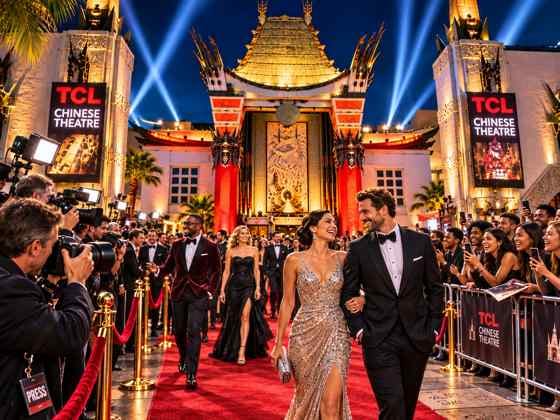 AI-generated illustration of a red-carpet premiere at TCL Chinese Theatre; not a photograph of an actual event. |
The Theater Kept Changing TooThe building has carried different names over the decades, hosted major premieres and served as the home of the Academy Awards for three ceremonies in the 1940s. The Academy’s official record confirms Grauman’s Chinese Theatre as the venue for the 16th Academy Awards in 1944. The premieres could be extraordinary spectacles in their own right. For the 1930 premiere of Hell’s Angels, the event extended beyond the auditorium into the Hollywood sky, with aircraft and dramatic outdoor entertainment. That sense of occasion helped make the Chinese Theatre a place where the arrival of a movie could become a story as memorable as the movie itself. During World War II, the theater hosted the Academy Awards ceremonies of 1944, 1945 and 1946. The 1944 ceremony, which honored films including Casablanca, reflected the wartime mood: service members were invited, and the ceremony reached troops by radio. It was another chapter in the theater’s role as a gathering place for the film industry. Modern upgrades changed projection technology and seating, but the basic experience still connects the present to the earliest years of moviegoing on Hollywood Boulevard. |
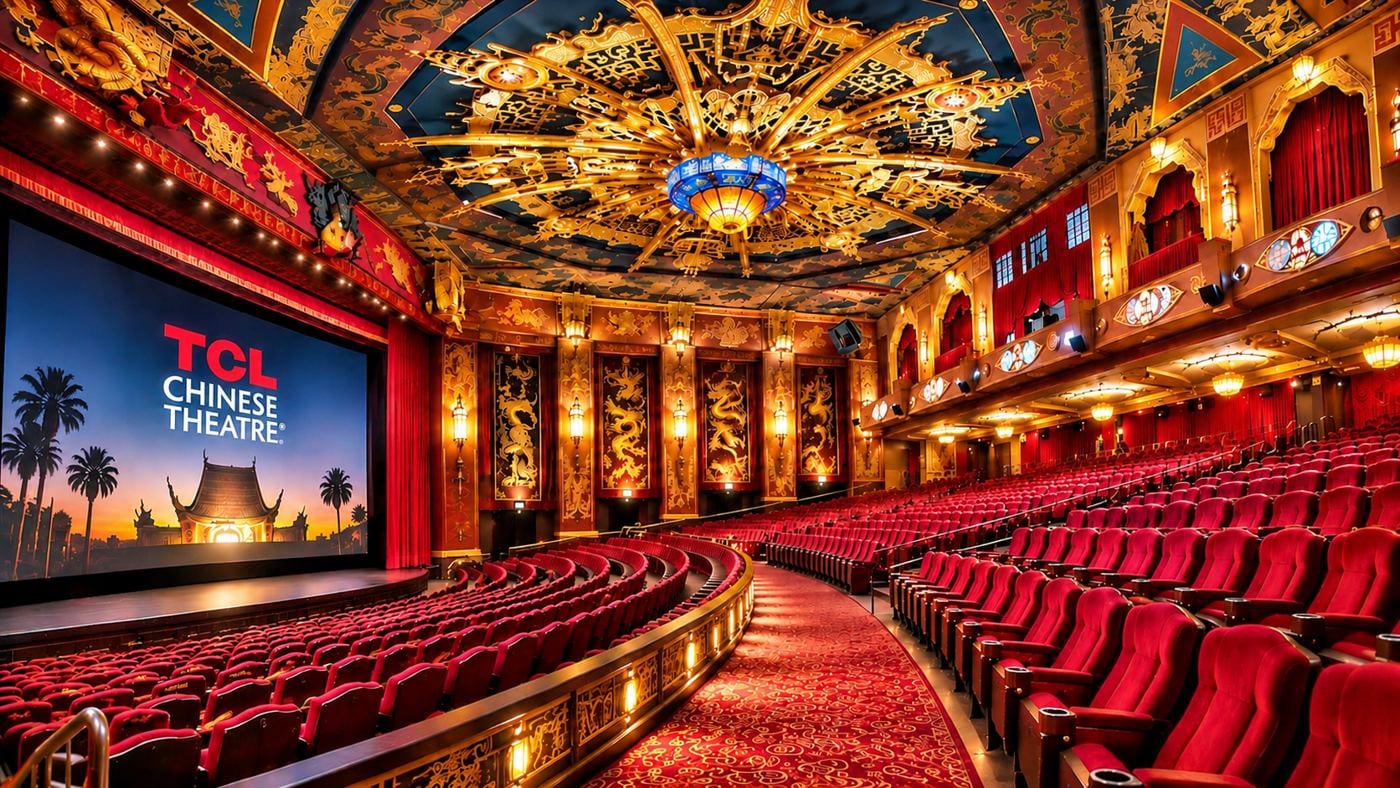 AI-generated editorial illustration of the TCL Chinese Theatre auditorium interior; not a documentary photograph. |
The Forecourt Is Still Part of the ShowHow Are Stars Honored in Cement?A cement-imprint ceremony is a special theater honor, not something every visiting performer receives. Honorees make impressions in a prepared slab and often add a signature or personal message. The ceremony itself becomes a public moment, linking a living performer to generations of Hollywood history. Not every famous actor has an imprint here. The collection reflects individual ceremonies held over many decades rather than a comprehensive ranking of stars. That makes each slab a record of a particular occasion as well as a tribute to a performer. What Should Visitors Notice in the Forecourt?Look closely at the lettering, hand shapes, footprints and playful inscriptions. These details give each impression a personality that a simple nameplate cannot capture. Comparing older and newer slabs also offers a glimpse of how Hollywood celebrity culture has changed. The forecourt sits outside the theater entrance on Hollywood Boulevard. Because the building remains an active cinema and premiere venue, visitor access can vary during special events. Checking the theater's official visitor information before arriving is wise. But the most rewarding experience is simple: slow down and examine the marks left by generations of performers. Why Is the Chinese Theatre Still Important?Because it is both a working theater and a historical object. Plenty of old buildings survive as museums. The Chinese Theatre still does what it was built to do: gather people for movies while carrying nearly a century of Hollywood ritual around them. And then there is the forecourt. A movie premiere disappears quickly. Lights come down, crowds leave and the boulevard returns to normal. But a hand pressed into cement can remain for generations. That may be the Chinese Theatre’s best trick. Hollywood is famous for making images that move. Here, some of its most memorable stories are the ones that stayed perfectly still. Can You Still Watch a Movie Inside the Historic Theatre?Yes. The Chinese Theatre remains a working cinema rather than a monument preserved only for tours. A major renovation in 2013 introduced IMAX technology and updated the auditorium while retaining the historic setting. For visitors, that creates an unusual combination: a modern movie presentation inside a landmark associated with Hollywood’s earliest premiere culture. That contrast helps explain the theater’s lasting appeal. Outside, the forecourt records moments from generations of screen history. Inside, audiences continue the same basic ritual that brought crowds to Hollywood Boulevard in 1927: gathering in the dark to watch a story unfold. SourcesTCL Chinese Theatres provides current venue information and historical background. Academy Museum documents the theater’s architecture, ceremonies, premieres and Oscar history. UCLA Library archival collection identifies the early handprint ceremony and its participants. |
0 Comments
Join the conversation
Be the first to comment
Share your thoughts above.