Hollywood & Vine: The Intersection That Became a Legend |
From dusty crossroads to radio-era celebrity shorthand, the corner tells a surprisingly human story of Hollywood's rise. |
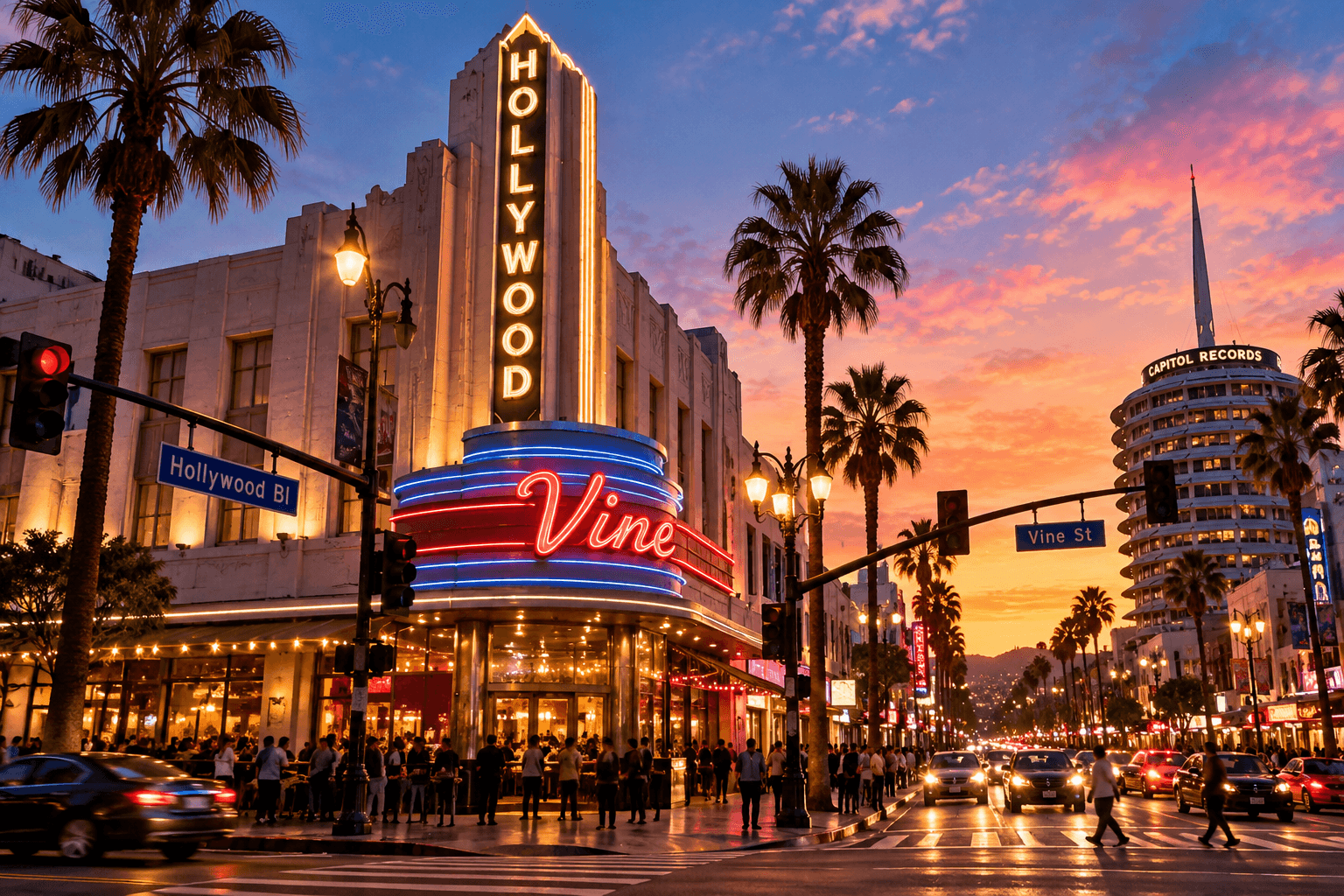
Hollywood has never been shy about turning an address into a promise. But few addresses worked harder than Hollywood and Vine. Two ordinary streets met here, and somehow their intersection became a place where strangers expected to glimpse a movie star, hear a radio celebrity, or at least brush against the business of making dreams. Today, traffic lights still do most of the directing. Yet the buildings around this corner tell a much longer story: of lemon groves and streetcars, office towers and theater marquees, radio microphones and a city learning how to sell its own mythology. Before Hollywood and Vine, There Was Prospect and WeyseOn an 1887 map of the young Hollywood subdivision, the streets had different names. Hollywood Boulevard was Prospect Avenue, and Vine Street was Weyse Avenue. The crossroads lay in a landscape of orchards and agricultural land, far removed from the glamorous shorthand it would become. PBS SoCal's Lost LA history traces the intersection to the subdivision associated with Harvey Henderson and Daeida Wilcox. Weyse Avenue became Vine Street first, taking its new name from grapevines that grew farther south. Prospect Avenue became Hollywood Boulevard when Hollywood consolidated with Los Angeles in 1910. What Was Hollywood and Vine Originally Called?Before they became Hollywood Boulevard and Vine Street, the roads were called Prospect Avenue and Weyse Avenue. Their intersection appeared under those names on an 1887 Hollywood subdivision map, decades before the corner became famous. A church stood on the southeast corner beginning in 1903. Within a generation, the quiet crossroads would be surrounded by businesses catering to a booming film town. Hollywood didn't become Hollywood overnight. It happened storefront by storefront, building by building, and eventually headline by headline. Why Is Hollywood and Vine Famous?Hollywood and Vine became famous during the 1920s and 1930s because movie-industry offices, entertainment businesses, theaters and radio activity clustered nearby. Newspapers, broadcasters and celebrity culture repeated the location so often that the intersection became a nationally recognizable symbol of Hollywood itself. When the Buildings Started Competing for AttentionThe Taft Building rose on the southeast corner in the 1920s, replacing the earlier church site. Its height announced a new kind of Hollywood: not merely a place where pictures were made, but a commercial center with offices, money and ambition. The Broadway-Hollywood department store followed on the southwest corner in 1927. The Equitable Building arrived at the northeast corner in 1929, while the Pantages Theatre opened a short distance east on Hollywood Boulevard in 1930. Together these buildings gave the intersection a skyline that could be recognized from blocks away. The old crossroads had learned a favorite Hollywood trick: make the entrance memorable. The Pantages remains part of that story, a movie palace that adapted to another era of entertainment. |
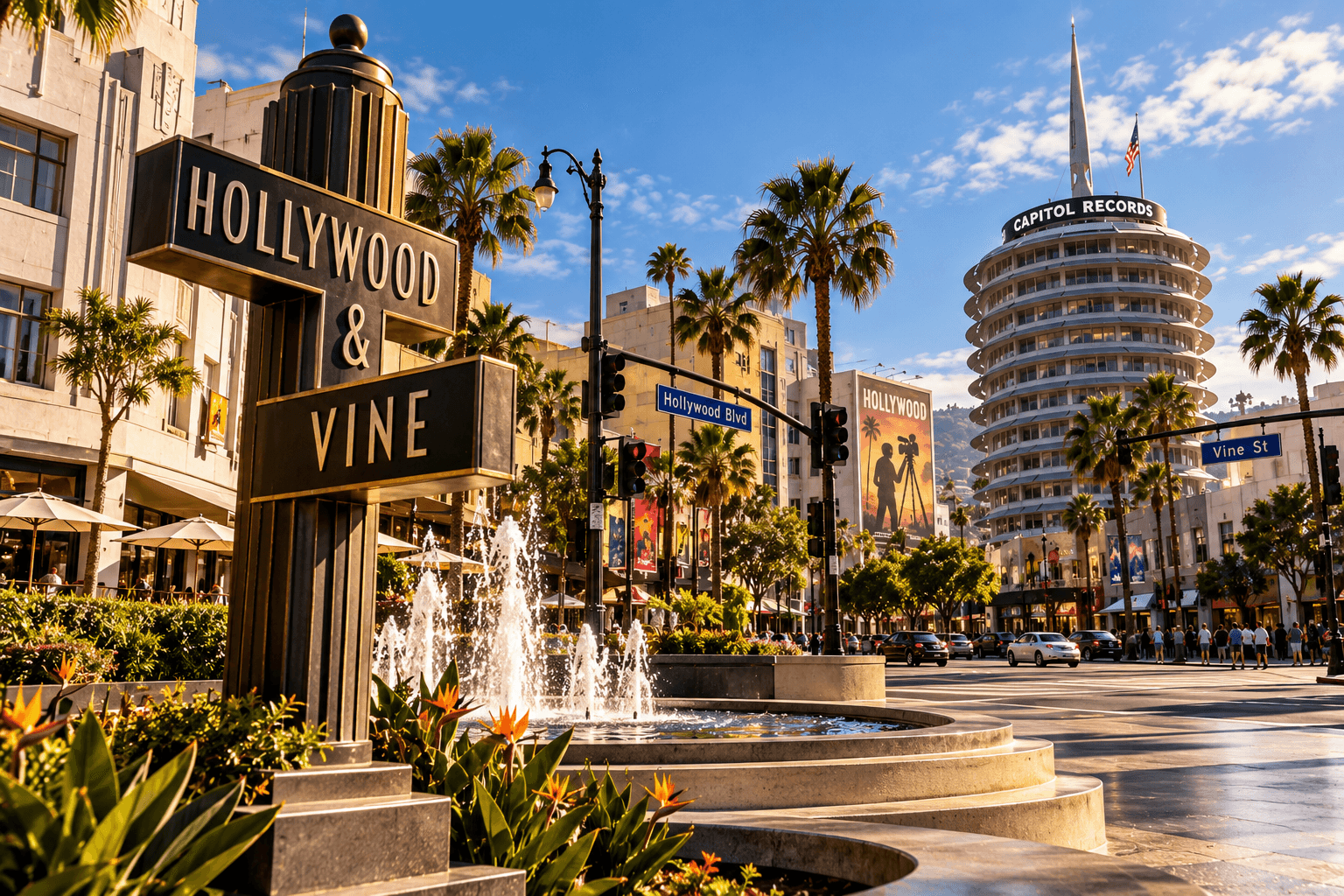 AI-generated imaginative illustration inspired by Hollywood and Vine; the sign, fountain and building arrangement are fictional, not an actual photograph of the intersection. |
Radio Gave the Corner a VoiceA place can be famous because people visit it. Hollywood and Vine became famous partly because people who had never been there heard its name. By the 1930s, radio broadcasts and entertainment reporting were helping turn the intersection into a verbal postcard from Hollywood. The radio business expanded around Vine Street and Sunset Boulevard. CBS's Lux Radio Theatre used a theater on Vine Street, and major networks developed substantial Hollywood facilities nearby. The City of Los Angeles's historic-context research documents this concentration of broadcasting activity. Microphones, orchestras and national audiences helped the district compete for cultural attention far beyond California. The magic wasn't that a performer necessarily stood on the corner. It was that saying 'Hollywood and Vine' could make a listener picture an entire industry. |
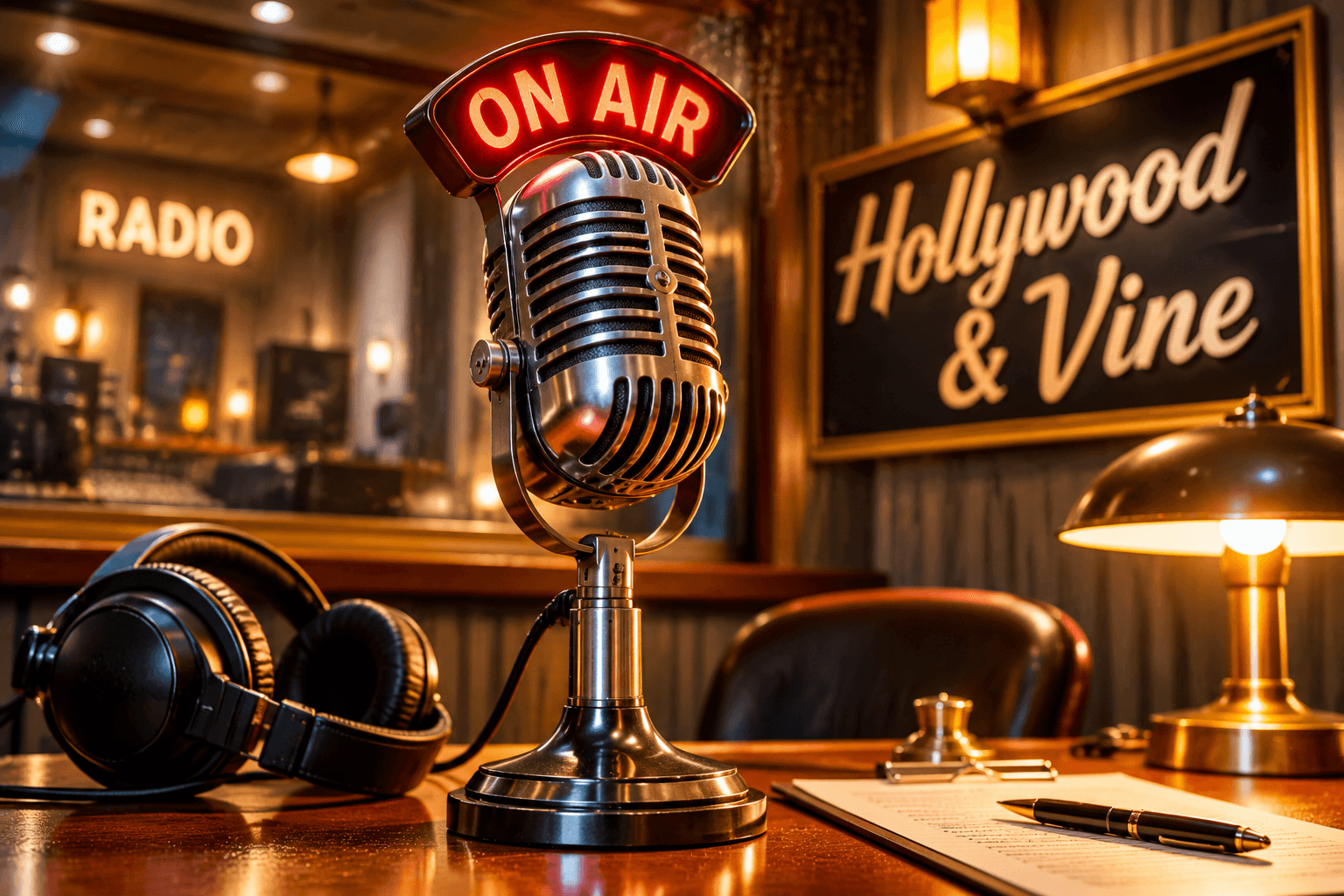 Original AI-generated illustration evoking Hollywood's golden age of radio; a fictional studio scene, not a historical photograph. |
A Record Tower Joins the NeighborhoodWalk north on Vine Street and another landmark takes over the view: the Capitol Records Tower, completed in 1956. Its circular design looks so much like a stack of records that the comparison feels inevitable. But the Los Angeles Conservancy notes that architect Louis Naidorf did not originally design it to resemble records; the shape was driven by practical design considerations. That detail is almost too perfect for Hollywood. The building acquired a musical metaphor without even trying. Its recording studios strengthened the area's connection to the entertainment industry, long after the intersection had already become a household phrase. The Stars Came to the SidewalkThe Hollywood Walk of Fame added a new reason to look down as well as up. Developed through the Hollywood Chamber of Commerce and installed beginning in 1960, the Walk extends along Hollywood Boulevard and Vine Street. The intersection became a meeting point between the entertainment industry's public mythology and the everyday act of walking to lunch, work or a bus stop. Our Hollywood Walk of Fame story follows the stars' origins and the unusual way a sidewalk became a global attraction. What Historic Buildings Can You See Near Hollywood and Vine?Notable landmarks in and near the intersection include the Taft Building, Broadway-Hollywood building, Equitable Building, Hollywood Pantages Theatre and Capitol Records Tower. They represent different chapters of Hollywood's growth, from 1920s commercial expansion to midcentury recording history. Building access and current tenants vary, so the most reliable way to appreciate their architecture is from public sidewalks. |
The Corner Never Stopped ChangingHollywood and Vine did not remain permanently frozen in its glamorous years. Like much of central Hollywood, it experienced economic decline and changing uses during the later twentieth century. Restoration, redevelopment and renewed interest in historic buildings brought further changes. Some beloved businesses vanished. Others moved in. The corner kept collecting layers. That is what makes this intersection worth examining beyond the familiar sign. Its fame was never just a single celebrity sighting or a perfect movie premiere. It came from the complicated life of a neighborhood where people worked, shopped, broadcast, waited, dreamed and sometimes went home disappointed. |
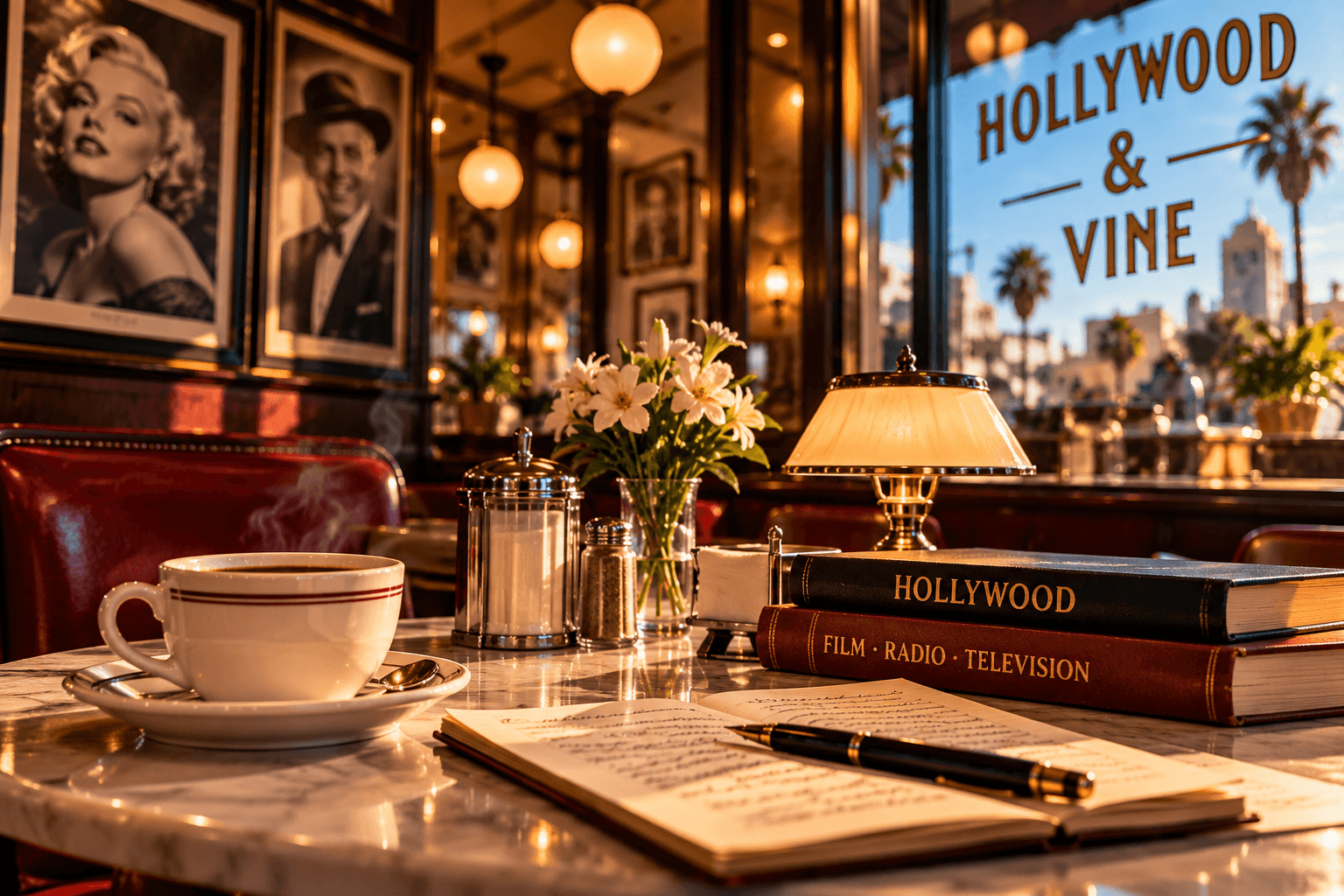 Original AI-generated illustration of an imagined vintage Hollywood café interior; not a photograph of an actual Hollywood and Vine establishment. |
Where Is Hollywood and Vine, and Can You Visit It?Hollywood and Vine is the intersection of Hollywood Boulevard and Vine Street in Hollywood, Los Angeles. It is a public street intersection, accessible by sidewalk, with the Hollywood/Vine Metro B Line station nearby. Visitors can see several historic exteriors on foot; individual businesses and building interiors have their own access rules. Watch: Hollywood & Vine Through the Years |
Two Street Names, One Hollywood StoryA century ago, a person standing at Prospect and Weyse would have seen a very different place. Today's corner has towers, traffic, stars set into pavement and decades of stories under its feet. The remarkable part is not that Hollywood made the intersection famous. It is that an ordinary crossroads proved sturdy enough to hold so many versions of Hollywood at once. Historical background: PBS SoCal's Lost LA, Los Angeles Conservancy, and Hollywood Walk of Fame history. |
28 Comments
Join the conversation
I always look at the Equitable Building when I'm stopped at that light. Knowing it dates to 1929 makes me appreciate it more.
There's something nice about the Pantages still drawing crowds, even if they're coming for a different kind of show now.
The part about radio makes sense. Hearing that address over and over probably did as much for its fame as the movies did.
I took visitors to Hollywood and Vine once, and they mostly noticed the traffic. Next time I'll point out the 1920s buildings.
The Taft Building replacing a church says a lot about how quickly that corner changed. I wonder what neighbors thought then.
I wish more people knew the names Harvey Henderson and Daeida Wilcox. Their subdivision became a pretty famous address.
Are there any old photos showing the corner with the church and orchards? It's almost impossible to imagine that view now.
The Pantages opening in 1930, after those office buildings, puts the whole area in perspective. It wasn't built in isolation.
I didn't know Hollywood became part of Los Angeles in 1910. That explains when Prospect Avenue got its new name.
Hollywood and Vine sounds glamorous, but most days it's a long wait at the light. The buildings are worth looking at, though.
The Broadway-Hollywood store must have been quite a sight when it opened. Anyone remember what was inside in its later years?
I pass that corner on the bus and never thought about the streetcars that came before. Now I'll be looking at it differently.
Was the church torn down specifically for the Taft Building? That's a whole piece of the corner's history on its own.
The old buildings deserve more attention than the star-spotting stories. I'm glad the Pantages is still being used.
My dad still calls Hollywood and Vine the center of everything. He'd get a kick out of the part about lemon groves.
I like knowing the street names from the 1887 map. Prospect and Weyse would make a good name for a history walking tour.
The Equitable Building and Taft Building went up so close together. That must have felt like a huge change for longtime residents.
It's funny that newspapers helped make one street corner famous. I wonder how many people went there expecting to see a star.
Seeing a show at the Pantages and then walking back past Vine is a fun night. That stretch still has some magic.
Did radio broadcasts actually happen at the intersection, or just in nearby buildings? I'd love to know which shows came from there.
The Taft Building really does stand out when you look up. Most people seem too busy watching the traffic to notice it.
I always assumed Vine was named for a vineyard right at the corner. Interesting that the grapevines were farther south.
My grandmother used to talk about shopping at the Broadway-Hollywood store. I never realized it opened way back in 1927.
The buildings are great, but crossing Hollywood and Vine on foot isn't much fun. I wish the corner felt more welcoming today.
That church on the southeast corner surprised me. I wonder if anyone photographed it before the Taft Building went up.
The Pantages is still my favorite building over there. You can feel some of the old Hollywood excitement when you walk in.
I had no idea Hollywood Boulevard was once Prospect Avenue. Hard to picture orchards where all that traffic is now.
Prospect and Weyse sound like such a different place. Does anyone know if any signs from those days survived?