
Hollyhock House: Hollywood's Frank Lloyd Wright Masterpiece |
Aline Barnsdall's daring hilltop home helped Los Angeles imagine a new kind of architecture. |
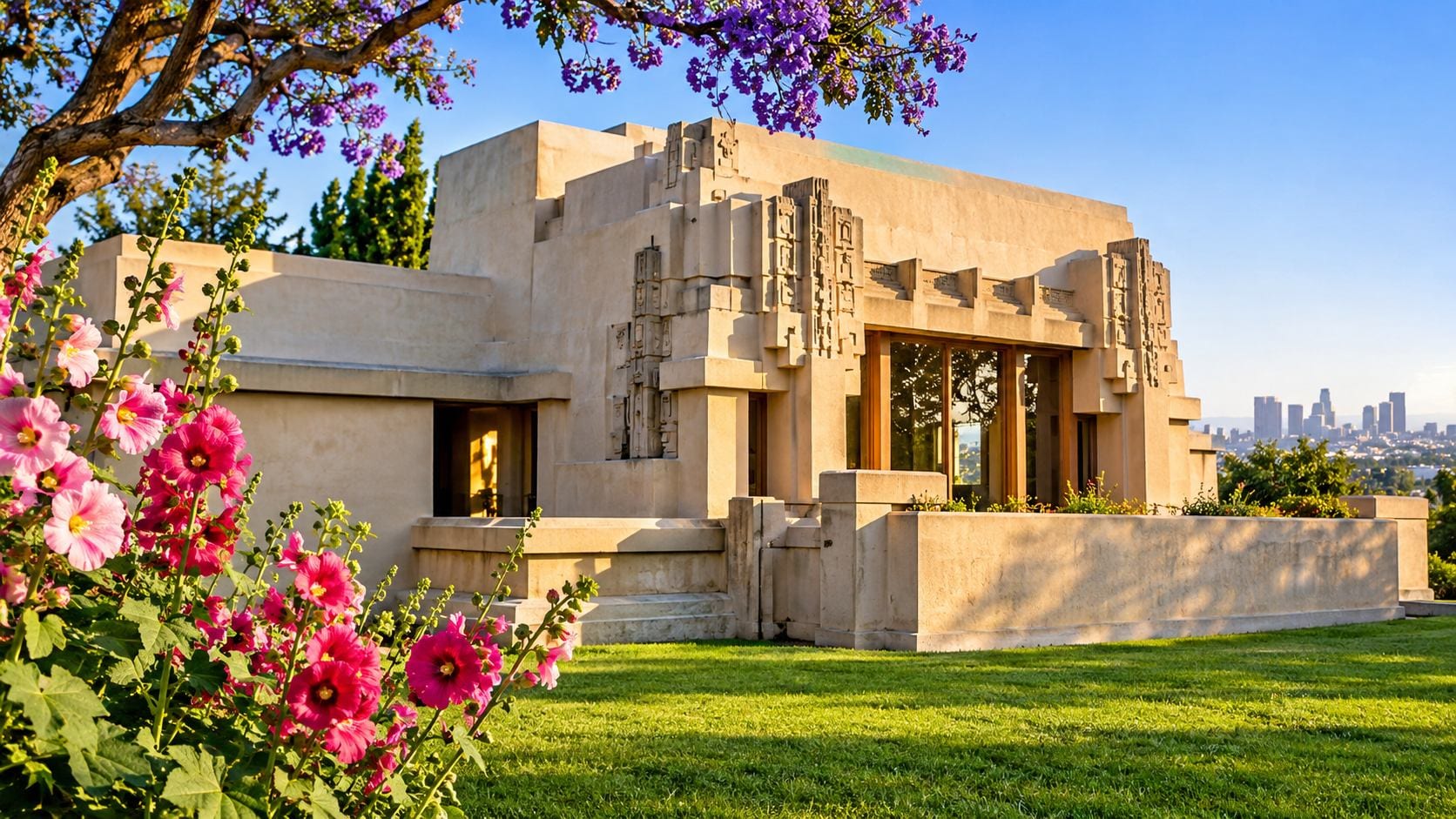
Hollywood has its share of houses that look ready for a film crew. But on a hill above Hollywood Boulevard stands one that helped change the way Southern California homes could look, long before modern architecture became a familiar part of the landscape.
Hollyhock House, the unmistakable creation of architect Frank Lloyd Wright, rises from Olive Hill with broad terraces, patterned concrete, and an unusual sense that the building is holding a conversation with the surrounding landscape. Its story begins not with a studio executive, but with a woman who wanted Hollywood to become a home for experimental art.
Who Was Aline Barnsdall?
Aline Barnsdall was the arts patron and theater producer who commissioned Hollyhock House from Frank Lloyd Wright. An oil heiress and independent-minded cultural figure, she saw Olive Hill as more than a place to build a home. When she acquired land on Olive Hill, her ambition reached well beyond a private residence: she imagined a lively cultural campus, with space for adventurous theater and artists.
The resulting house was built between 1919 and 1921, when Hollywood itself was still becoming the entertainment capital the world would recognize. The Los Angeles Department of Cultural Affairs identifies the house as Wright's first Los Angeles commission and the only Wright residence in the city open to the public.
Most of Barnsdall's larger cultural plan was never completed. That unfinished ambition matters: Hollyhock House is not simply an eccentric mansion with an interesting owner. It is a surviving piece of a much larger dream about what a city's cultural life could become.
|
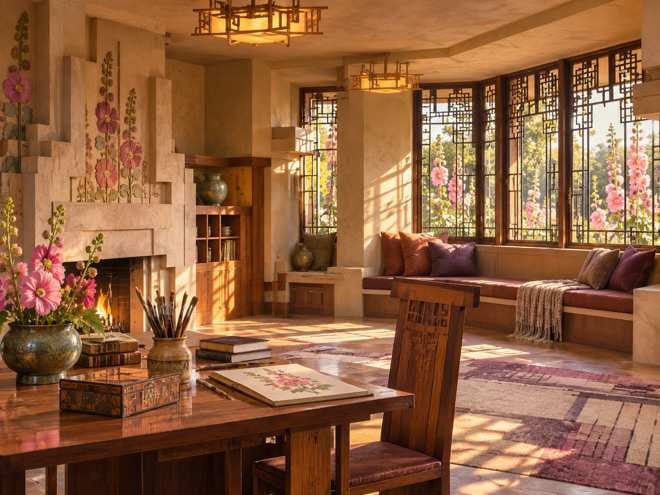 AI-generated illustration evoking Aline Barnsdall's artistic vision; not an actual photograph of Hollyhock House. |
Why Is It Called Hollyhock House?
Hollyhock House is named for Aline Barnsdall's favorite flower, the hollyhock. Wright transformed the tall garden bloom into a repeating architectural motif, rather than naming the house after its location or shape.
Look closely at the abstract stone ornament, art glass, and carefully designed decorative elements. The flower appears again and again, translated into geometric lines rather than copied like an illustration in a gardening book.
The effect is part of the building's charm. A personal preference becomes the visual language of an entire home. Wright was not content to design the walls and leave the personality to someone else.
|
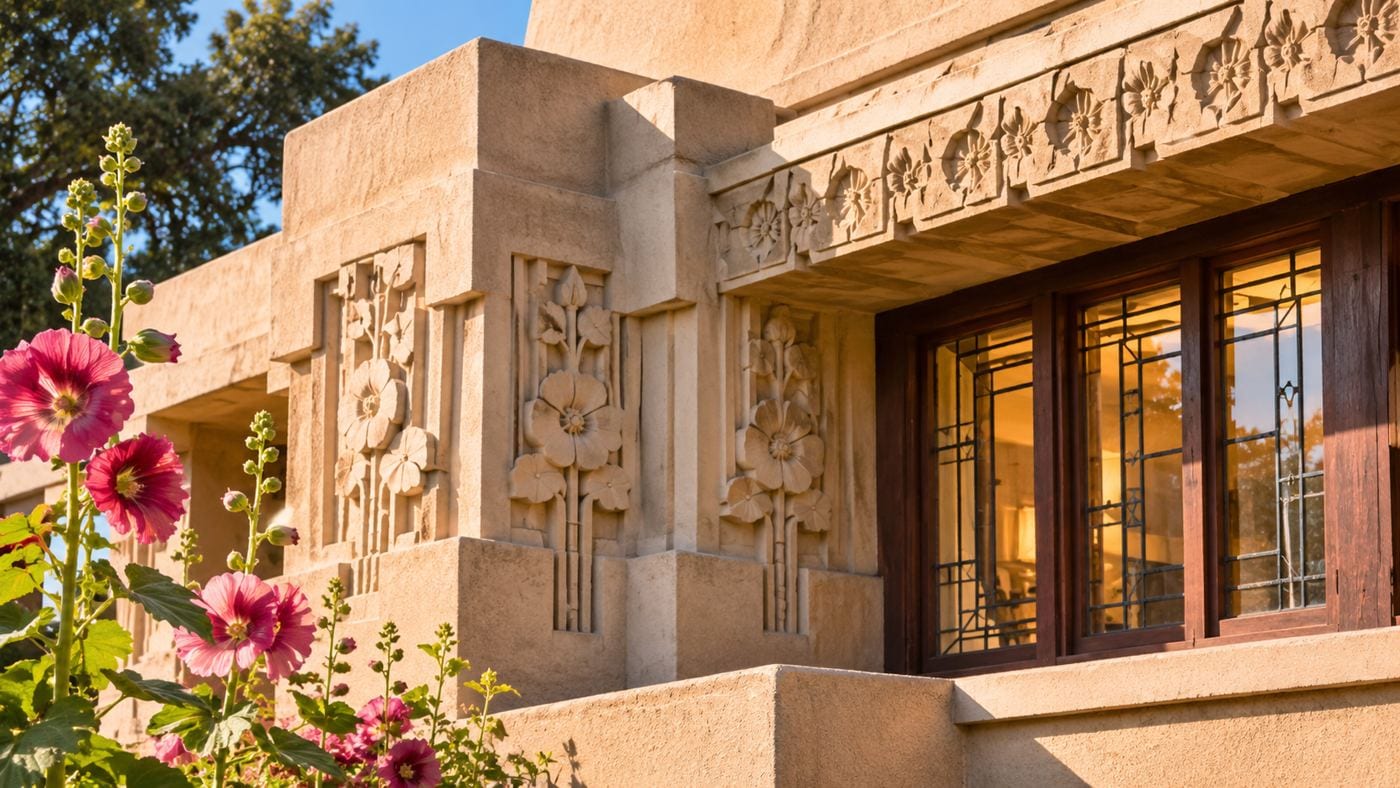 AI-generated editorial illustration inspired by Hollyhock House's hollyhock motifs; not an actual photograph. |
An Architectural Experiment on Olive Hill
The house brought together hefty concrete forms, sheltered passages, gardens, courtyards, water features, and terraces. Its angles and ornament can suggest ancient architecture, yet the arrangement also responds to the openness of Southern California.
Los Angeles planning research describes Wright's approach here as "California Romanza," his term for an expressive regional architecture. The home's outdoor connections helped point toward a distinctly California way of living, one in which rooms, patios, and landscape were never entirely separate.
Wright's ideas did not emerge from one person's hands alone. His son Lloyd Wright and architect Rudolph Schindler played important roles in seeing the project through. The house later became part of the story told about the emergence of California modernism.
What Makes Hollyhock House Important to Architecture?
Hollyhock House matters because it helped introduce Frank Lloyd Wright's experimental ideas to Los Angeles, linking indoor and outdoor spaces in ways that influenced Southern California architecture. Its importance reaches beyond its distinctive appearance and connects Wright's work to architects who shaped the region for decades.
In its architecture, the hilltop house also tells a story of creative experimentation: a distinctly personal design with influence far beyond Olive Hill.
Why Is Hollyhock House a UNESCO World Heritage Site?
Hollyhock House is recognized by UNESCO for its contribution to the development of modern architecture. In 2019, it became Los Angeles's first UNESCO World Heritage Site as part of The 20th-Century Architecture of Frank Lloyd Wright, a group of eight buildings selected for their architectural innovation and influence. The UNESCO listing explains that worldwide significance.
That honor recognizes design achievement, not celebrity ownership. In a place so skilled at celebrating what is new, preserving a bold idea can be as important as inventing the next one.
|
From Private Vision to Public Treasure
In 1927, Barnsdall donated the house and part of her Olive Hill property to the City of Los Angeles. The gift established a foundation for public access to the arts, even though the original campus she imagined had remained incomplete.
The home's story since then has included periods of use, deterioration, careful preservation, and restoration. Major work on its public rooms helped bring back details that earlier generations could easily have missed.
Today, the house is part of the broader Barnsdall Art Park arts campus. Readers interested in the surrounding hilltop and its neighborhood role can explore our separate Barnsdall Art Park feature. Here, the focus is the remarkable home at the center of that history.
|
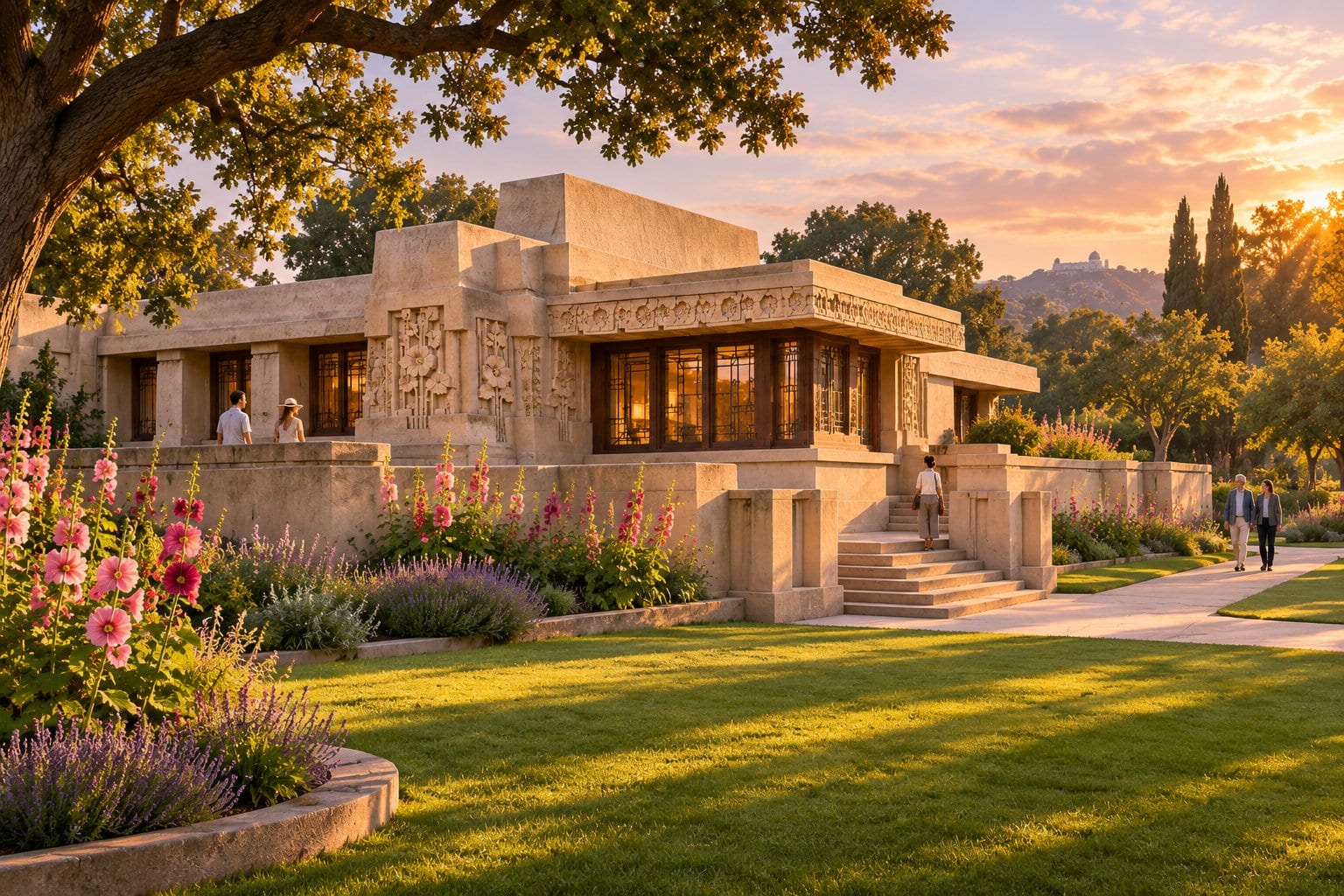 AI-generated artistic illustration of Hollyhock House's living legacy and gardens, not an actual photograph of the site. |
What Can You See Inside Hollyhock House?
Inside Hollyhock House, visitors can appreciate Wright’s geometric design, carefully planned rooms, decorative details, and the relationship between the interior and surrounding outdoor spaces. The house’s historic living areas and art-glass features help reveal Barnsdall’s creative ambitions. Access to specific rooms may vary to protect the landmark, so check the official site for the current visitor route.
Can You Visit Hollyhock House in Hollywood?
Yes. The city operates Hollyhock House as a historic house museum with self-guided visits. It is located at 4800 Hollywood Boulevard. Because schedules, ticketing and accessibility arrangements may change, check the official Hollyhock House website for current tour details rather than relying on old admission information.
For people who cannot visit in person, the official website also offers a virtual accessibility experience, allowing visitors to explore the house and its collections remotely. That digital option makes the architecture available well beyond the hilltop.
Watch: A Closer Look at Hollyhock House
This architectural video introduces the design, Aline Barnsdall, and the historic importance of Hollyhock House.
A Hollywood Landmark With a Different Kind of Star Power
The most memorable thing about Hollyhock House may be that it feels both grand and unexpectedly personal. Its bold concrete geometry speaks to a new architectural language, while a favorite flower quietly repeats across the building.
Barnsdall imagined an arts community; Wright imagined a new design vocabulary for California. Their plans did not unfold exactly as either expected. Yet more than a century later, Hollywood has a house that preserves both ambitions, and a public place where people can keep discovering them.
|
4 Comments
Join the conversation
I used to walk near Olive Hill after work. Next time I'm over there, I'm going up to see Hollyhock House.
The patterned concrete looks cool, but I wonder how comfortable the house actually was to live in.
Wright's first LA commission and it's open to the public? I've passed that hill so many times without knowing.
I had no idea Barnsdall wanted a whole arts campus on Olive Hill. Wish more of that plan had happened.