Whitley Heights: Hollywood's Mediterranean Village Above the Boulevard |
The hillside homes, movie-star history and freeway losses behind one of Hollywood’s most distinctive historic neighborhoods. |
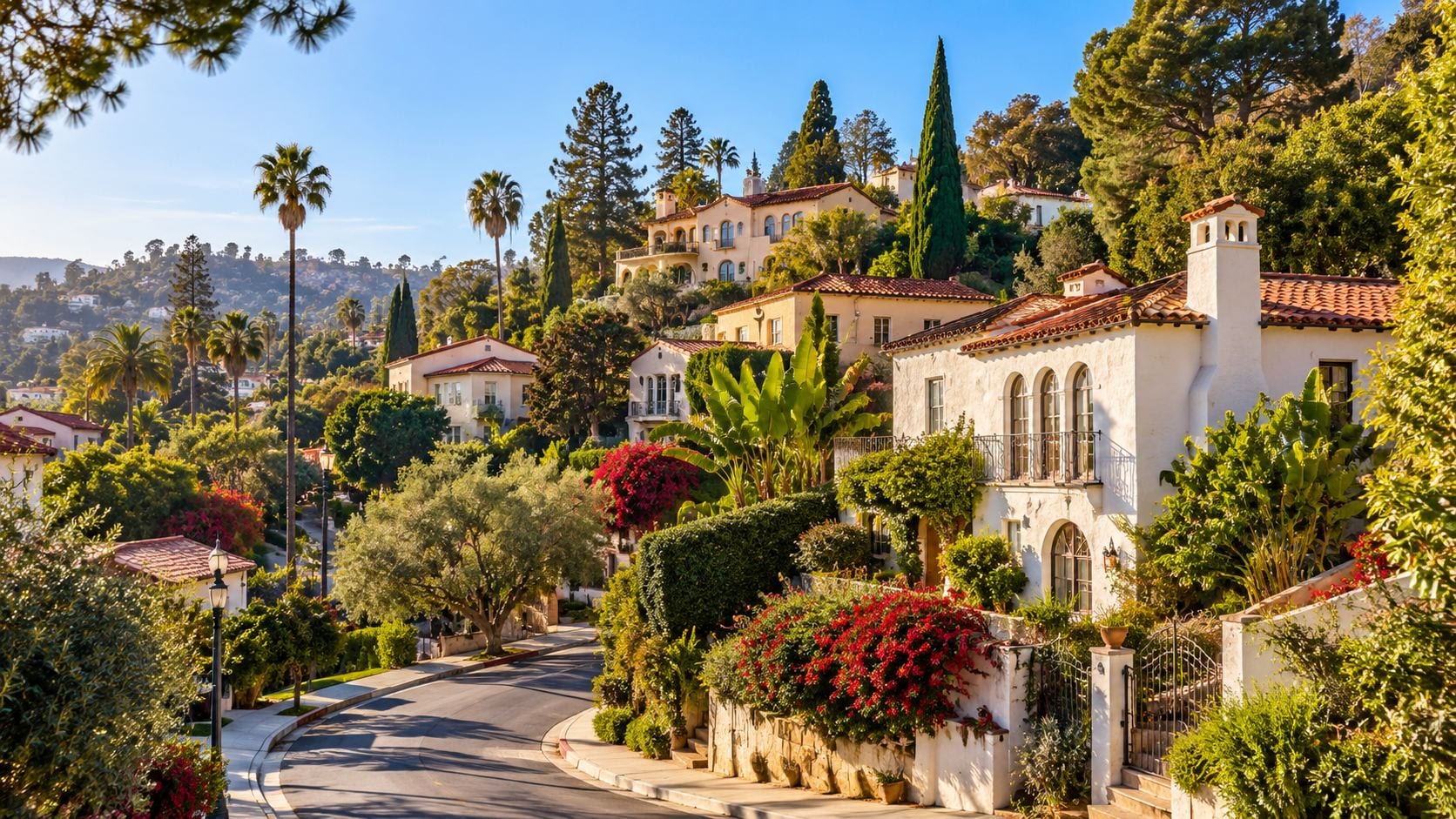
A few turns above Hollywood’s busy streets, the scenery changes. Stucco walls meet red-tile roofs. Stairways follow the hillside. Curving roads seem less concerned with getting somewhere quickly than with showing you what is around the next bend. This is Whitley Heights, a residential pocket of Hollywood designed to feel like a Mediterranean village long before old-world atmosphere became a familiar Los Angeles real-estate description. The surprise is not that Hollywood built something theatrical. It is how much of this particular vision has survived. The neighborhood is a living community, not a backlot or a museum. Yet its narrow streets and historic houses offer an unusually clear view of the era when movie stars were becoming household names and the city itself was still inventing its look. The Hillside That Became a VillageDeveloper Hobart John Whitley, an important figure in Hollywood’s early growth, saw an opportunity in the slopes north of Franklin Avenue. According to Los Angeles City Planning, he considered Whitley Heights a crowning achievement and engaged architect Arthur S. Barnes to study Mediterranean architecture and landscaping. Barnes designed most of the neighborhood’s residences from 1918 to 1928. The vision reached beyond individual houses: terraced sites, winding roads, retaining walls, outdoor steps and design controls helped create the impression of a connected hillside settlement. Instead of imposing a tidy street grid on steep terrain, the plan worked with the contours. Houses gained individual character while sharing a visual language of stucco, tile, arches, balconies and garden walls. Here, even a staircase could be part of the neighborhood’s architecture. Where Is Whitley Heights in Hollywood?Whitley Heights sits in the Hollywood Hills north of Franklin Avenue and east of the Hollywood Bowl area, near the Hollywood Freeway. It is primarily residential. The precise boundaries of the historic preservation zone are defined by the city’s official maps, rather than by a single tourist landmark. |
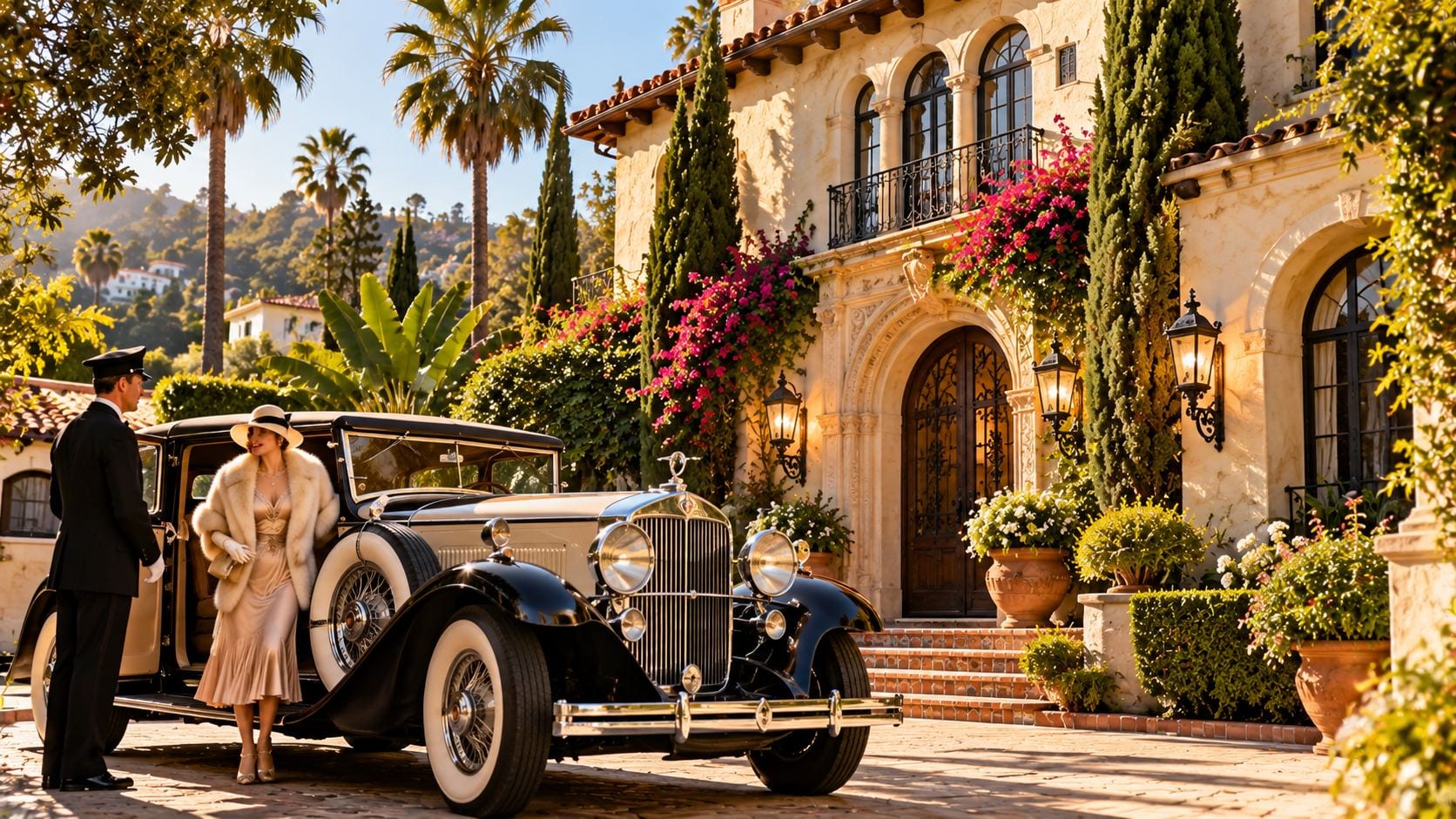 AI-generated period illustration inspired by Hollywood's 1920s residential glamour; not an archival photograph or a documented Whitley Heights address. |
When Hollywood's Famous Faces Came HomeWhitley Heights became attractive to people whose names filled marquees and entertainment pages. The city identifies former residents including Rudolph Valentino, Gloria Swanson, Tyrone Power, Rosalind Russell, Judy Garland and Marlene Dietrich. The neighborhood association also documents writers and performers associated with the district across different eras. That history is easy to romanticize, but there is something more interesting beneath the celebrity roll call. The neighborhood offered an address apart from the public life below, with homes designed around views, gardens and relative seclusion. Stars who were constantly seen on screen could have a place where the architecture, rather than the publicity machine, took center stage. Not every famous person lived here at the same time, and not every surviving house can be confidently attached to a particular star. The better story is the neighborhood itself: how a new entertainment industry helped shape a new residential landscape. Which Hollywood Stars Lived in Whitley Heights?Documented residents include silent-film star Rudolph Valentino and actress Gloria Swanson, followed in later periods by figures such as Tyrone Power and Rosalind Russell. Historic accounts also identify other performers and writers. Specific house histories should be checked against documented property records before assigning a celebrity to an address. |
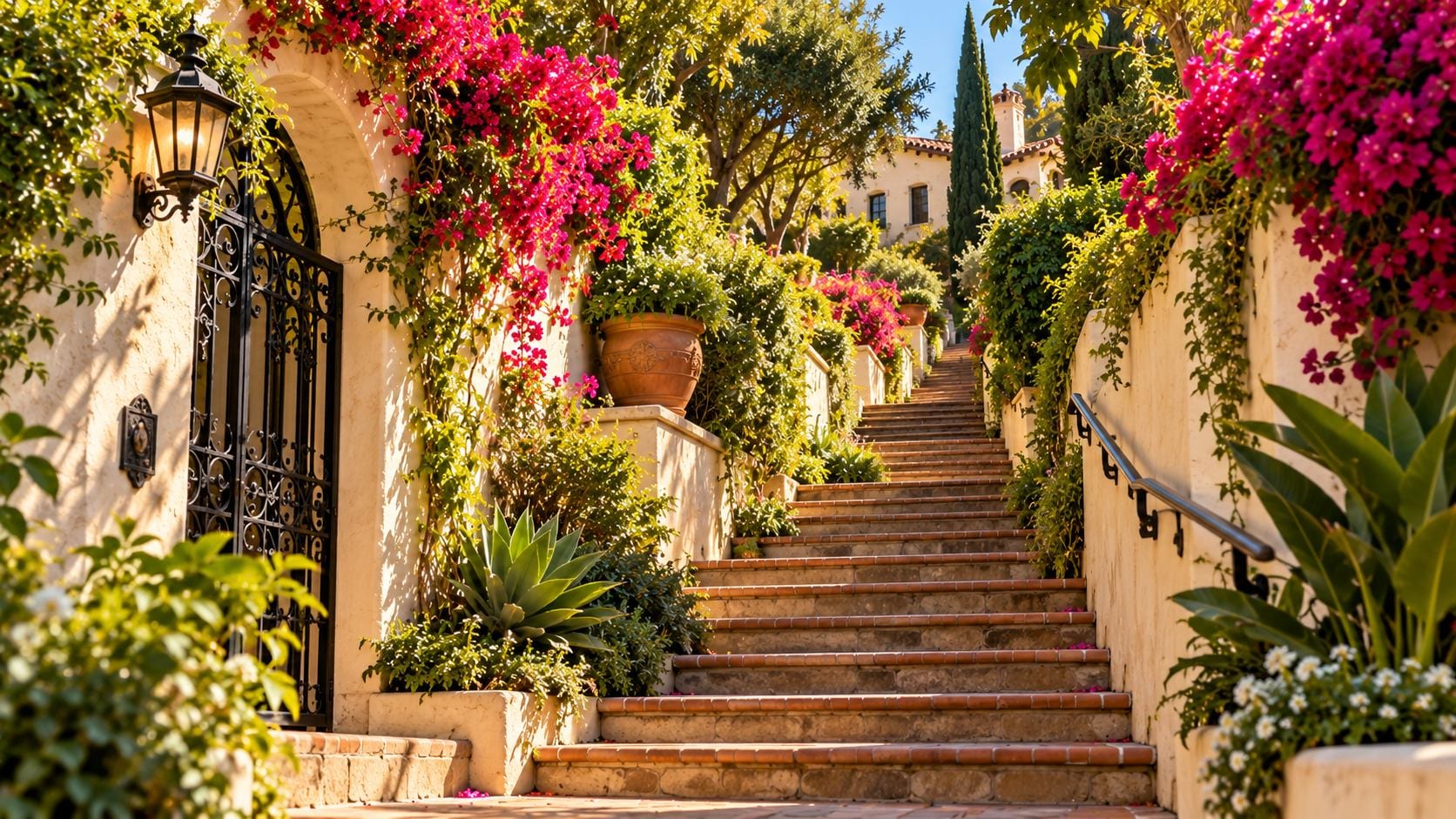 AI-generated illustration of a Mediterranean-style garden stairway inspired by Whitley Heights architecture; not a photograph of an actual neighborhood location. |
The Architectural Details That Tell the StoryWhitley Heights helped popularize Mediterranean and Spanish Colonial Revival ideas in Los Angeles. The Los Angeles Conservancy describes a coordinated design approach, including hillside roads, pedestrian steps, retaining walls and guidelines intended to preserve the village character. Look at the neighborhood as a composition rather than a collection of expensive houses. A curved wall supports the next terrace; a flight of steps negotiates an awkward grade; a tiled roofline appears above a cluster of trees. Those small decisions explain why the streetscape feels coherent even when individual homes differ. The historic architecture is not identical from one property to another. Preservation records describe both the prevailing Mediterranean character and later stylistic variations. The result is more interesting than a perfect replica of somewhere overseas: it is a distinctly Los Angeles interpretation. What Architectural Style Is Whitley Heights Known For?The district is especially associated with Mediterranean Revival and Spanish Colonial Revival architecture. Typical features include stucco exteriors, red-tile roofs, arches, wrought-iron details, landscaped terraces and stairways shaped by the hillside. These are characteristic features, not a promise that every house has every detail. |
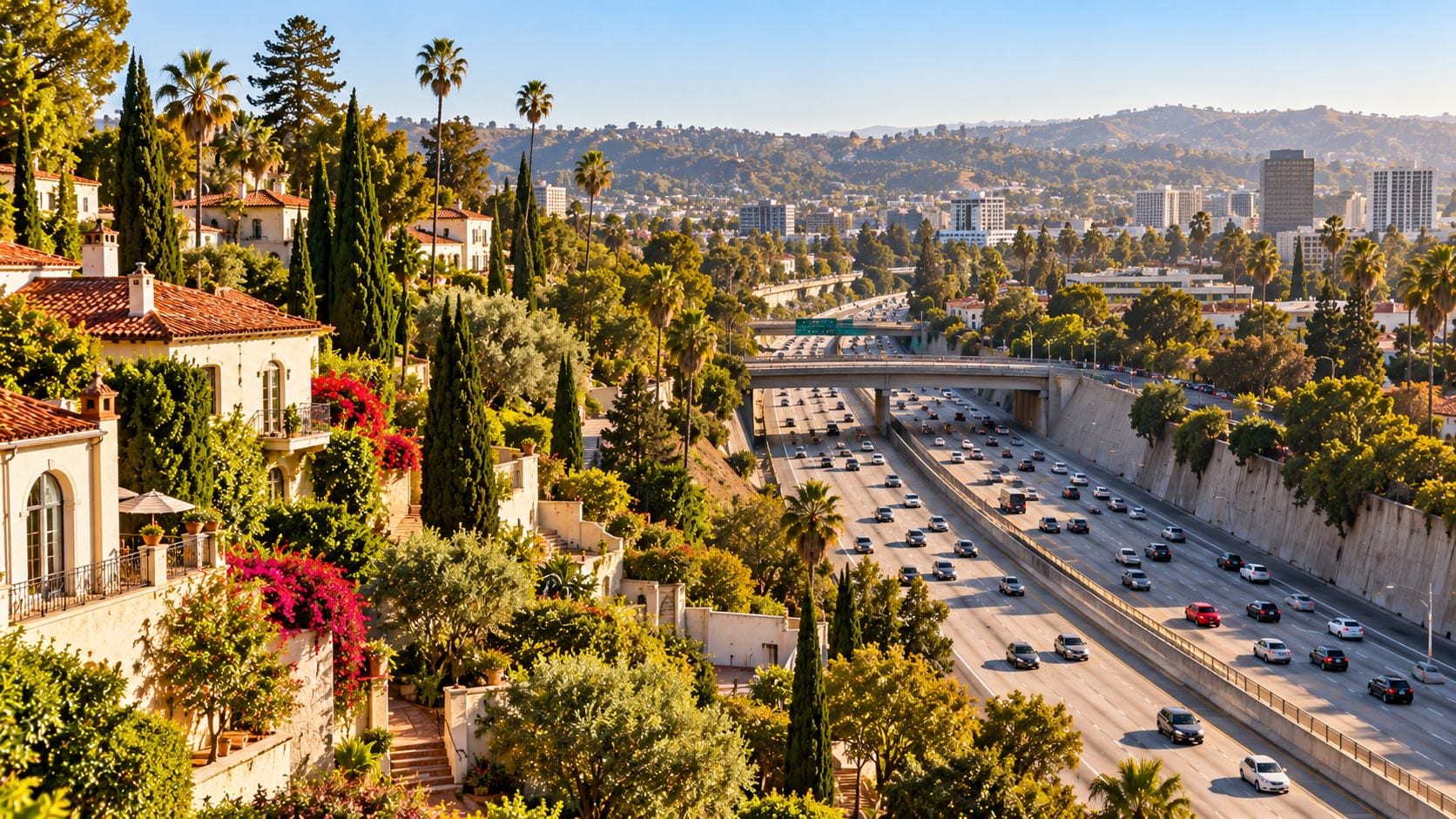 AI-generated conceptual illustration contrasting hillside homes with a major freeway; not a photograph of Whitley Heights or the actual Hollywood Freeway alignment. |
What the Freeway Took AwayThe Hollywood Freeway changed the district in a way no thoughtful garden wall could disguise. Construction beginning in the 1940s cut through the neighborhood, removed numerous houses and divided its original layout. City historic research identifies Valentino’s former residence on Wedgewood Place among the losses. That is an important part of the Whitley Heights story. The surviving homes tell us what the planners hoped to create; the freeway shows what mid-century Los Angeles was prepared to sacrifice for a different vision of movement and growth. The contrast can be felt in the map itself: a neighborhood originally designed as a connected hillside environment was interrupted by an infrastructure project serving a much larger city. Its surviving sections continue to carry the character of the earlier plan. How Did the Hollywood Freeway Change Whitley Heights?Freeway construction destroyed houses and physically split portions of the original neighborhood. The loss included significant early Hollywood properties. The district that remains is therefore a preserved part of the original development, not an untouched reproduction of its 1920s layout. Watch the story: This short film traces Hobart J. Whitley’s role in Hollywood and the neighborhood’s changing history. Some details in its narration may differ from primary historic records. Why Preservation Matters HereResidents and preservation advocates worked to protect what remained. Whitley Heights was listed in the National Register of Historic Places in 1982, and Los Angeles established its Historic Preservation Overlay Zone in 1992. These designations recognize the district’s architectural and historical importance and provide a framework for reviewing changes. The city’s preservation rules do not freeze ordinary neighborhood life. Houses still need maintenance, families still come and go, and landscapes change. The point is to keep those everyday changes from quietly erasing the features that make the place identifiable. That balance is one reason Whitley Heights is worth knowing even if you never climb one of its streets. It offers a practical lesson in how a city can choose to remember something after already losing a great deal of it. Is Whitley Heights a Historic District?Yes. Whitley Heights was listed in the National Register of Historic Places in 1982 and became a Los Angeles Historic Preservation Overlay Zone in 1992. Those designations recognize its historic hillside planning and architecture. The city’s preservation review helps protect the neighborhood’s character while allowing appropriate maintenance and changes to private homes. A Neighborhood, Not a Movie SetWhitley Heights is best appreciated as an architectural and community story rather than a celebrity-home hunt. Its houses are private homes; there is no invitation to wander onto driveways, approach front doors or treat residential stairways as a film location. For those curious about its history, the Los Angeles City Planning historic district page provides an official starting point. The Los Angeles Conservancy’s Holly Hill Terrace residence profile explains how the original development worked, and the Whitley Heights Civic Association history offers additional local context. Hollywood has plenty of places designed to catch your eye in an instant. Whitley Heights asks for a different kind of attention: notice the curve of a road, the way steps meet a terrace, and how a neighborhood can hold onto its identity while the city around it keeps moving. |
28 Comments
Join the conversation
Those curves must make Whitley Heights feel far from Hollywood’s busy streets, even though it’s only a few turns away.
A walk through there sounds tempting, but I’d stick to the public streets and give residents their space.
I didn’t know the area was north of Franklin. Hollywood changes so fast down below, so it’s nice this pocket remains.
I’m impressed Barnes planned the roads and terraces along with the houses. That explains why it feels like a neighborhood.
The streets sound beautiful for a walk, but those steep stairs would wear me out pretty quickly.
I’m glad the city has a historic preservation zone there. Once those garden walls and stairways are gone, they’re gone.
Stucco, arches, balconies and tile could sound repetitive, but on a winding hillside I bet every house looks different.
The design controls probably helped keep the streets looking connected. I’d be curious how current homeowners feel about them.
I wonder whether those outdoor steps are still useful to residents or mostly just a beautiful piece of the neighborhood.
I walked near the Hollywood Bowl once and didn’t realize this neighborhood was so close. I’ll pay more attention next time.
The Mediterranean village idea sounds theatrical, but I appreciate that people actually live there. It isn’t a movie set.
I always associate old Hollywood with theaters, not hillside homes. This part of its history is pretty interesting.
The preservation zone having official boundaries makes sense. I’d be interested to see which blocks are actually included.
I’d rather see the city protect places like Whitley Heights than let every old house get replaced with a giant box.
It’s surprising how close this is to the Hollywood Freeway. Does the traffic noise reach those upper streets?
The part about a staircase being architecture stuck with me. That’s a nice way to think about those hillside steps.
I’m curious about the gardens Barnes studied. Are there any original plantings left, or mostly the buildings and walls?
Those roads may look charming, but I wouldn’t want to meet a delivery truck on one of the narrow bends.
I had no idea Whitley thought of this as his crowning achievement. Makes me want to learn more about his plans for Hollywood.
I like that the houses have their own character while still looking like they belong together. You don’t see that everywhere.
The retaining walls caught my attention. Do they still have to follow the original design rules when repairs are needed?
I’ve taken the wrong turn above Franklin before and ended up on those curvy streets. Pretty views, stressful driving.
It’s wild that Barnes designed most of those homes between 1918 and 1928. That’s a lot of history on one hillside.
Whitley Heights is residential, so I hope people remember that when they go looking for old Hollywood houses.
I wonder how much of Arthur Barnes’s work is still visible from the street. The stairways sound especially interesting.
The red-tile roofs and garden walls sound lovely. I’m glad so much of that original village feel has survived.
Working with the hillside instead of forcing a street grid makes so much sense. Those winding roads must be something to navigate, though.
I’ve driven along Franklin for years and never knew Whitley Heights was up there. Are the outdoor stairways easy to spot?