The Ship on Sunset Boulevard: Hollywood’s Forgotten Shopping Experiment |
At 6671 Sunset Boulevard, a Streamline Moderne “ship” has been anchored in Hollywood since 1936—and it once promised shoppers a trip around the world. |
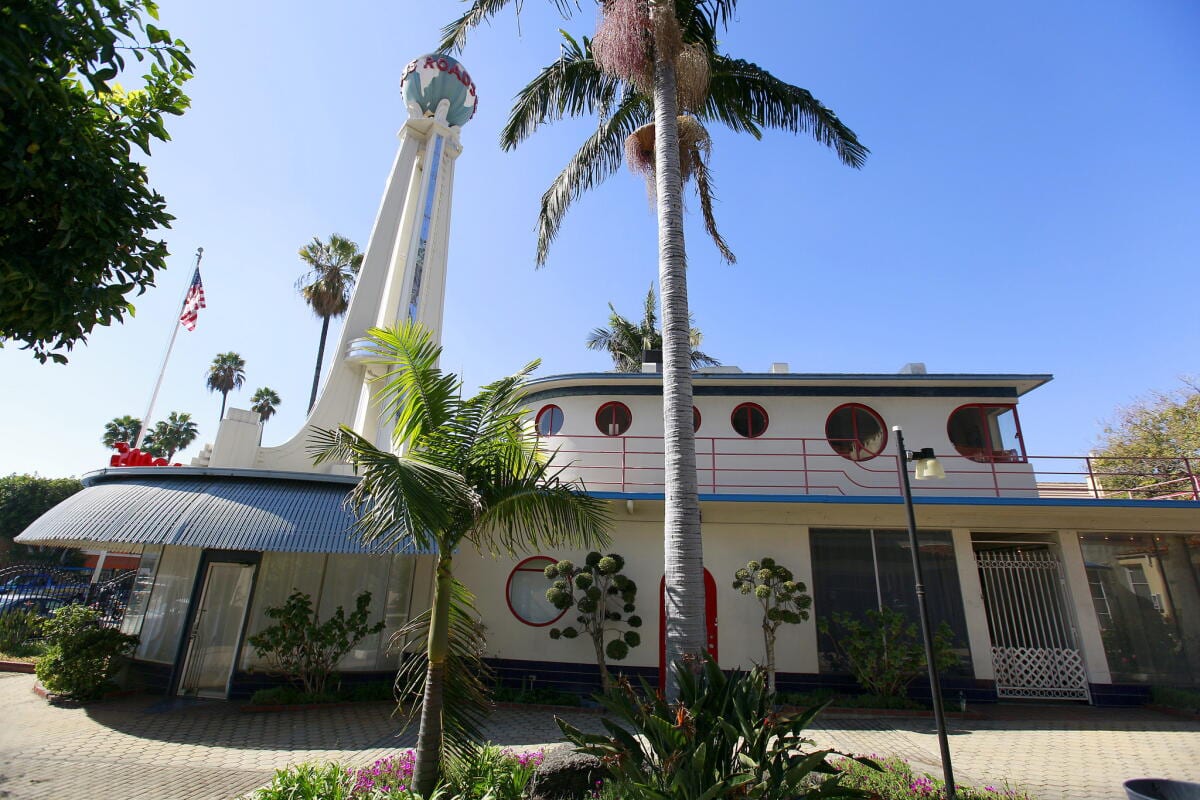
There is a ship parked on Sunset Boulevard.
It has portholes. Railings. A curved white hull.
And a tall tower topped by a globe announcing CROSSROADS OF THE WORLD.
It has also been sitting at 6671 Sunset Boulevard since 1936.
No water required.
The “ship” is the Streamline Moderne centerpiece of Crossroads of the World, one of the country's early outdoor shopping centers and one of Hollywood's most wonderfully theatrical pieces of commercial architecture.
Because apparently ordinary shopping wasn't quite Hollywood enough. Go Shopping. See the World.Architect Robert V. Derrah designed Crossroads as a pedestrian-oriented shopping destination with a wonderfully ambitious idea.
Visitors wouldn't simply move from store to store. They would move through architectural versions of the world.
The complex combined the nautical Streamline Moderne centerpiece with buildings drawing on styles including Spanish, Mediterranean, French and other European influences. The result felt less like a conventional retail center and more like a movie backlot designed for shoppers.
Which, in Hollywood, probably felt perfectly reasonable. |
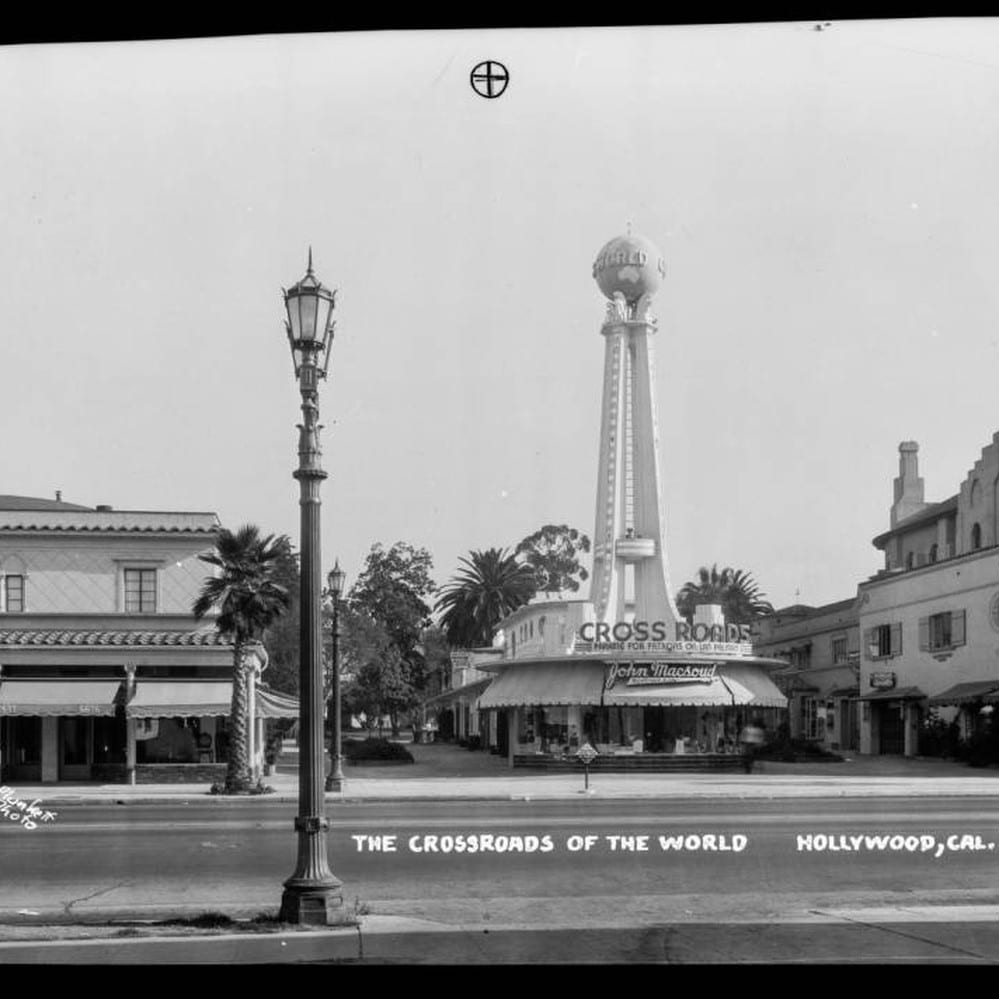 Crossroads of the World soon after its 1936 debut. Photo source: Calisphere. |
A World’s Fair on Sunset BoulevardCrossroads opened during the Great Depression, when international travel was far beyond the reach of many families.
The fantasy was part of the attraction.
The Los Angeles Conservancy says boosters envisioned the complex as a kind of permanent World's Fair, offering shoppers a glamorized taste of faraway places through architecture, merchandise and atmosphere.
When it debuted in 1936, the opening received the kind of attention normally reserved for a movie premiere.
That's another detail I love.
Hollywood wasn't merely selling things.
It was already learning how to turn the act of going somewhere into a show.
What makes Crossroads especially curious is the way it asked people to explore on foot. Instead of presenting one long row of storefronts to the passing automobile, it invited shoppers to turn corners, cross a courtyard and notice the details overhead. The buildings themselves became part of the attraction.
That idea feels familiar now. We expect a shopping district to offer more than a place to buy things: somewhere to linger, take a photograph or bring a friend. Crossroads was already inviting people to make an afternoon of it. The shopping bags were almost beside the point.
And the ship at the center made the invitation impossible to miss. Even someone with no intention of buying anything could look up from Sunset Boulevard and wonder why a vessel had apparently run aground in the middle of the city. Thankfully, nobody had to check the tide tables before going shopping.
The experiment didn't remain purely retail. During the 1940s and 1950s, Crossroads increasingly became an office complex. Tenants over the years included the Screen Actors Guild, Standard Oil and American Airlines, followed later by creative businesses connected to Hollywood's entertainment world.
|
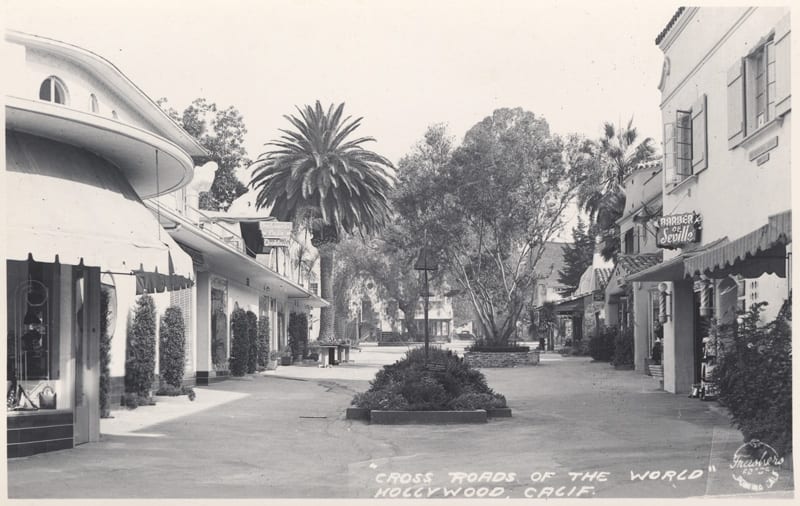 The pedestrian court at Crossroads of the World in the 1930s. Photo source: Martin Turnbull. |
The Ship That Hollywood KeptBy the 1970s, Crossroads faced demolition.
It survived.
The complex was designated Los Angeles Historic-Cultural Monument No. 134 in 1974 and listed in the National Register of Historic Places in 1980. More recent development plans around the property have also incorporated preservation of the historic Crossroads buildings.
That's worth noticing because Hollywood has never been shy about replacing yesterday with tomorrow.
Crossroads did something harder.
It stayed strange.
You can read more about the architecture and preservation history through the Los Angeles Conservancy.
And the next time you're moving along Sunset Boulevard, look for the globe.
Then look below it.
There is still a ship sitting in the middle of Hollywood, surrounded by buildings meant to make Depression-era shoppers feel as if they'd gone around the world.
Hollywood has always understood something about imagination.
Sometimes you don't have to travel very far at all.
If you like finding the stories hiding inside buildings you've passed a hundred times, subscribe to Hollywood Local Pulse. I'll keep looking for the ones that refuse to disappear. |
More from Hollywood Local Pulse
Oct 14, 2026
Hollywood's $450 Million Echelon Studios Takes Shape
A new five-stage studio campus rises on Santa Monica Boulevard as local production faces economic headwinds.
Oct 12, 2026
Hollywood Burbank Airport New Terminal: October 13 Opening
Hollywood Burbank Airport's new terminal opens October 13. Find the new entrance, parking changes and what Elevate BUR means for travelers.
0 Comments
Join the conversation
Be the first to comment
Share your thoughts above.