Franklin Village: The Little Hollywood Block With a Long Memory |
A walkable stretch of 1920s storefronts, books and neighborhood history |
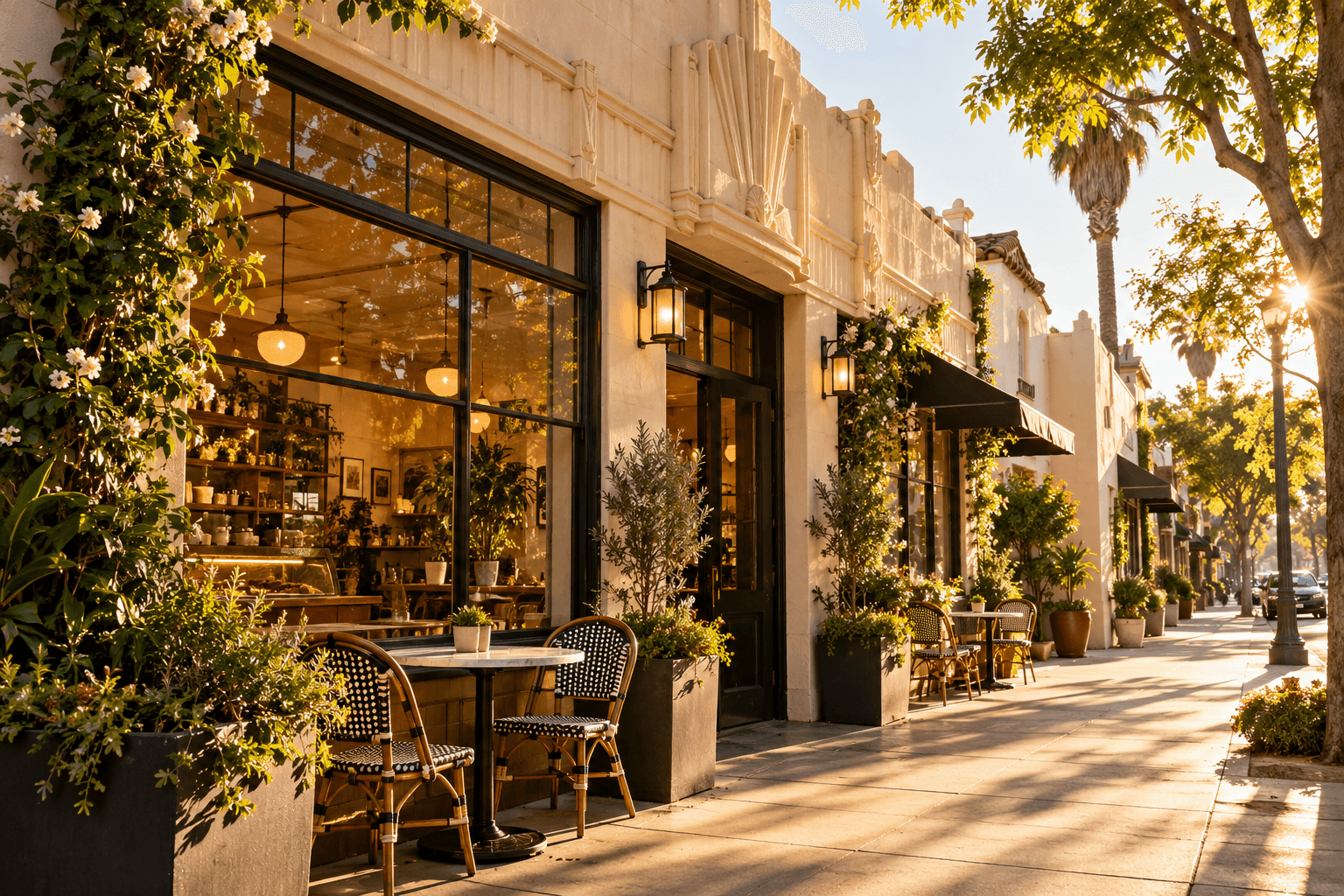
Hollywood is very good at making an entrance. Franklin Village has a different talent: persuading you to stay awhile. Along a short stretch of Franklin Avenue, old storefronts, books, coffee and neighborhood history share a sidewalk. It feels almost suspiciously manageable for Los Angeles. The surprise is not that this little commercial strip has charm. It is that its charm has an architectural explanation, and nearly a century of ordinary neighborhood life behind it. The Hollywood Block Built for Everyday ErrandsThe City of Los Angeles identifies the north side of the 5900 block of Franklin Avenue, between Tamarind and Bronson avenues, as the Franklin Village Commercial Historic District. Its historic-resources survey describes three one- and two-story commercial buildings with approximately twenty storefronts, built right up to the sidewalk instead of hiding behind parking lots. Two of those buildings contribute to the district's historic significance. The city's documented period of significance is 1926 to 1929, when the storefronts took shape. By the end of construction in 1929, the commercial block was known as the Franklin Strip. That is a remarkably solid foundation for a neighborhood nickname. The block grew in the streetcar era, less than half a mile from the Pacific Electric line on Hollywood Boulevard. People could walk from nearby homes, pick up necessities and run into neighbors. What feels pleasantly old-fashioned today was once simply the practical way a neighborhood worked. |
Why Franklin Village Feels DifferentA storefront at the sidewalk changes the whole conversation. Instead of crossing a broad parking lot, you pass windows, doors and other people. The next business is only a few steps away. There is time to notice a display, decide on a coffee or change your mind about going straight home. The surrounding streets add their own layers: vintage apartment buildings, smaller homes and hills rising to the north. The city's historic-resources survey documents the Franklin Avenue commercial strip as a compact, pedestrian-oriented district shaped by the streetcar era. That physical arrangement helps explain why the block still feels different from the sprawling commercial corridors elsewhere in Los Angeles. Where Is Franklin Village in Hollywood?Its historic commercial heart is the north side of the 5900 block of Franklin Avenue between Tamarind and Bronson avenues in Hollywood, Los Angeles. People also use Franklin Village to describe the surrounding residential area, which extends beyond the specifically surveyed commercial block. To see how the storefronts and nearby residential streets connect, this walking tour offers a street-level look at Franklin Village and Hollywood Grove. The neighborhood, rather than a Hollywood landmark montage, is the star. The footage helps explain why this corner of Hollywood rewards a slower pace: the shops, sidewalks and homes form one connected neighborhood, not a collection of isolated destinations. |
 AI-generated illustrative café still life, not an actual photograph of Franklin Village. |
Books, Coffee and a Place to LingerThe story of a neighborhood is rarely told by architecture alone. Shops give it a memory. Counterpoint Records & Books is a fine example of a business long associated with the pleasure of browsing instead of racing through a checkout line. In a 2019 VoyageLA interview, founders John and Susan Polifronio recalled starting with a tiny sublet in a frame shop, selling books and records while learning the business as they went. Susan described the care and knowledge of the people who helped customers browse. Their story is a reminder that a neighborhood's character grows from the people who keep its doors open. What Is Franklin Village Known For?Franklin Village is known for its compact, walkable commercial strip, 1920s storefront architecture, and longstanding associations with booksellers, cafes and small-scale entertainment. Individual shops and performance schedules may change, but the street's pedestrian-oriented historic design is an enduring feature. |
 AI-generated illustration of a fictional bookstore interior, not an actual Franklin Village business. |
The Architecture Has Its Own BackstoryThe commercial strip is modest in height, but its surroundings are anything but plain. Older Hollywood neighborhoods often place architectural ambition beside everyday practicality. Franklin Village's broader setting includes apartments and homes in varied early twentieth-century styles as well as larger landmark buildings. One prominent neighbor is the former Château Élysée on Franklin Avenue, originally conceived as a grand hotel and apartment residence. Its French-Norman-inspired appearance is a reminder of Hollywood's architectural ambitions during the early twentieth century. It is part of the wider architectural story of this corner of Hollywood, although it should not be confused with the city's narrowly defined commercial historic district. The contrast is part of the pleasure: a grand facade can stand within walking distance of a little shop window. Hollywood has always made room for spectacle and an ordinary Tuesday. A Neighborhood Shaped by People, Not Just BuildingsFranklin Village did not freeze in 1929. Restaurants opened and closed, theaters found new audiences and residents saw changes in the mix of people and businesses. Polifronio's recollections trace some of those shifts over decades. They are more revealing than pretending any neighborhood has one permanent personality. The old storefronts have had to make room for new purposes. Their significance is not in preserving one shop sign forever, but in maintaining a human-scale setting where local businesses can continue to exist. Is Franklin Village a Historic District?Yes. Los Angeles's SurveyLA inventory identifies the Franklin Village Commercial Historic District on the north side of the 5900 block of Franklin Avenue. The inventory recognizes an intact collection of 1920s streetcar-related commercial development. This survey identification does not mean every building in the surrounding neighborhood has individual landmark protection. |
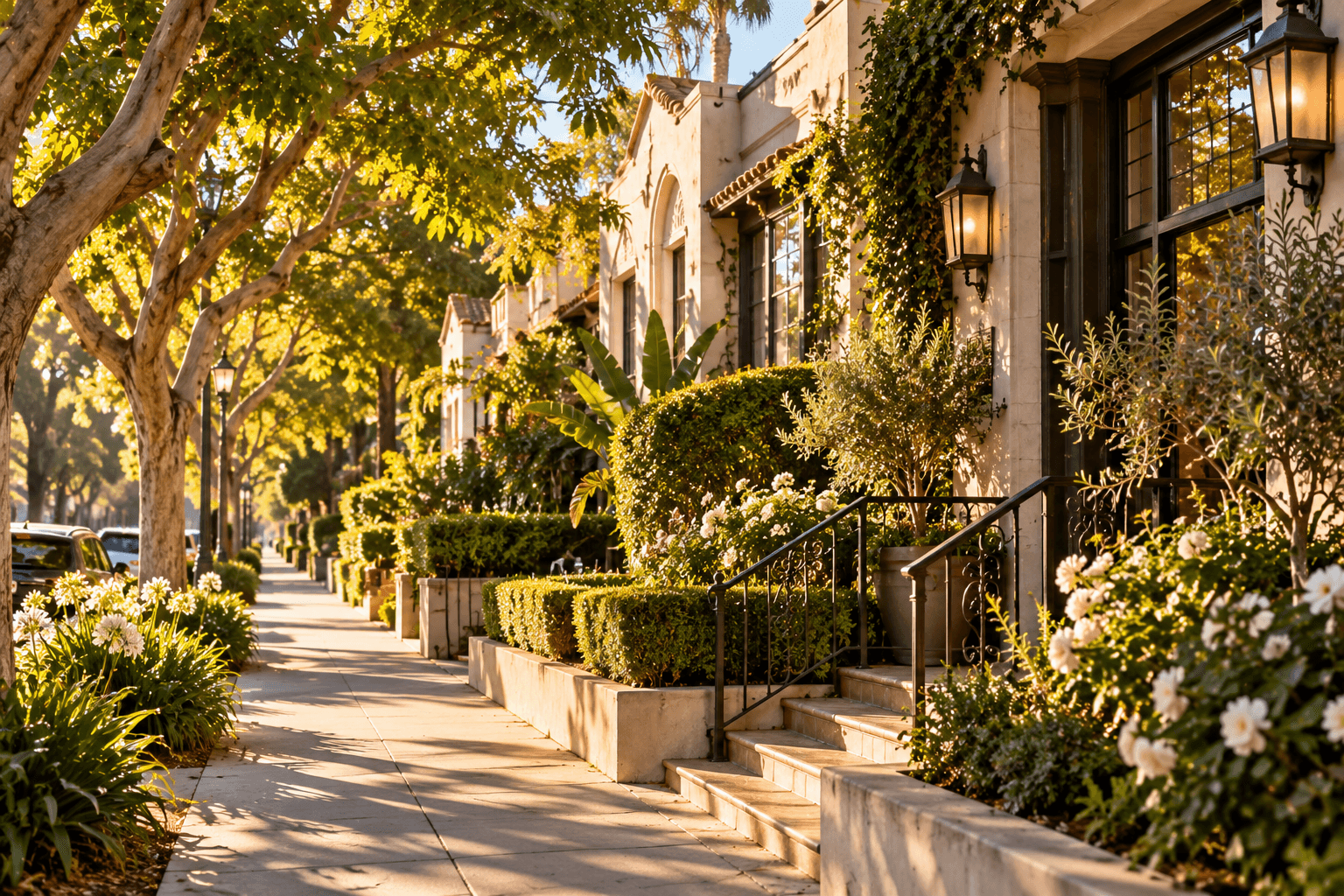 AI-generated illustration of a leafy Southern California neighborhood street; not an actual photograph of Franklin Village. |
How to Appreciate the Village Without Rushing ItA short walk is enough to understand the block's rhythm. Look at the scale of the storefronts, the way doors open onto the sidewalk and how the commercial strip meets nearby residential streets. If you stop for a book or a drink, let the business itself be the destination rather than treating the neighborhood like a movie set. As with any residential part of Hollywood, respect private entrances, keep sidewalks clear and check individual businesses for current hours before making a special trip. This is a place people live and work, not a permanent open-air attraction. Can You Explore Franklin Village on Foot?Yes. Its historic commercial center is compact and pedestrian-oriented, making the storefronts easy to explore on foot once you arrive. Walking conditions, accessibility, traffic and parking vary on surrounding streets; plan accordingly and do not assume every route is step-free. The Hollywood Story That Fits on One BlockNot every Hollywood story needs a premiere, a famous name or a sweeping view of the sign. Sometimes the most revealing story is the block where people bought a book, met a friend or took a chance on a little business. Franklin Village is proof that the city built for spectacle also made room for something quieter: a neighborhood with a long memory and a reason to keep coming back. For the architectural record, see the City of Los Angeles SurveyLA historic-resources report. |
28 Comments
Join the conversation
What did people buy on the Franklin Strip in 1929? I'd love to see an old shop list.
The old storefronts are charming, but the mix of books and coffee is why I keep going back.
A block built for everyday errands sounds pretty good right now. I wish my neighborhood had one.
I hope the historic designation doesn't make it too hard for small shops to fix things.
I pass Tamarind and Bronson all the time and never thought of that side as one connected block.
Three buildings and around twenty shops is a lot packed into a short stretch.
Are any of the original storefront signs still tucked away under the newer ones?
The part about people running into neighbors on errands is sweet. That still happens at the coffee shops.
Historic or not, I'd love a safer crossing near those shops. More people would walk over.
I remember walking that block years ago and thinking it felt different. Never knew why.
Franklin Village feels quieter than the rest of Hollywood. Those low buildings probably help.
I wonder if the storefronts were all the same size in 1929. Some look pretty narrow now.
Half a mile from the old streetcar line is farther than I expected. Still a decent walk, though.
I stop for books there sometimes and end up lingering. That sidewalk really does pull you in.
It's nice that the city documented the 1926 to 1929 buildings. Hopefully they stay useful, too.
Does anyone know what businesses were there when the Franklin Strip first opened?
The lack of a parking lot out front is probably why I always notice this block.
I didn't realize the whole stretch between Tamarind and Bronson had a historic designation.
Was the Pacific Electric stop on Hollywood Boulevard close enough for people to carry groceries home?
My grandma used to talk about running errands on foot in Hollywood. This block helps me picture it.
I like the shops, but crossing Franklin can take some patience. The sidewalk is the nice part.
The old streetcar connection makes sense. It still feels like a place meant for walking.
Twenty storefronts on one block sounds like a lot, but it never feels crowded when I'm there.
Only two of the three buildings count toward the historic district? I'm curious what changed with the third one.
I walk past those shops on my way to coffee. Now I'll actually look up at the buildings.
The Franklin Strip is a great old nickname. Does anyone still call it that?
Buildings right up to the sidewalk make such a difference. I wish more LA blocks felt like that.
I had no idea the storefronts went back to the 1920s. Were they always shops?