
Cinerama Dome History: Hollywood’s Movie Theater From the Future |
The 1963 concrete landmark, its giant curved screen, and the campaign that saved it |
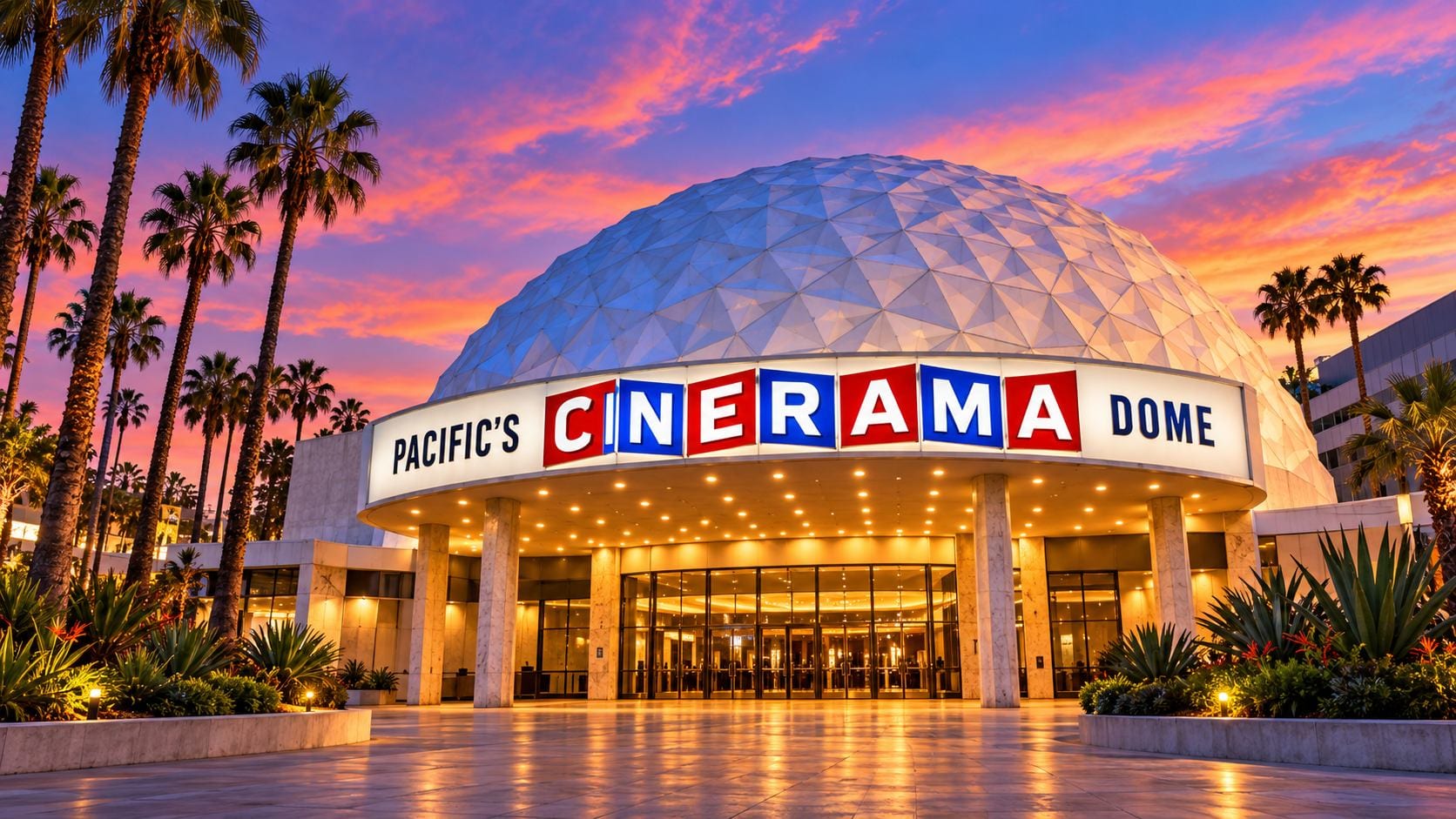
The Movie Theater That Looked Like TomorrowOn Sunset Boulevard near Vine Street, Hollywood built a movie theater that looked as though it had arrived from another planet. The Cinerama Dome was not crowned with columns or decorated with gilded angels. It wore a vast shell of geometric concrete, a structure that seemed perfectly suited to the space-age optimism of 1963. Even on a boulevard accustomed to making an entrance, this was something new. A Theater Designed for a Bigger PictureThe idea behind the Dome began with Cinerama, an ambitious attempt to make movies feel larger than life. Its original process used three synchronized projectors to cast a wide image across a deeply curved screen. The effect was designed to fill the audience’s peripheral vision. In an era when television was becoming a permanent fixture in American living rooms, theaters needed to offer something the living-room set could not. The answer was not merely a bigger screen. It was an experience. |
How the Concrete Dome Was BuiltPacific Theatres commissioned Welton Becket and Associates to create an economical, repeatable theater design. Pierre Cabrol was a principal designer, and the concept drew on the geodesic engineering of R. Buckminster Fuller. The finished structure used 316 interlocking precast concrete panels, forming a roof that rose more than 70 feet. The building was conceived as a prototype for a whole network of similar cinemas. That network never materialized as planned. Instead, Hollywood kept the remarkable original. The theater's construction schedule was extraordinarily compressed, driven by a premiere deadline that left little room for hesitation. When Was the Cinerama Dome Built?The Cinerama Dome was completed in 1963 and opened on November 7 of that year. Its distinctive concrete shell was designed by Welton Becket and Associates, with Pierre Cabrol as a principal designer. |
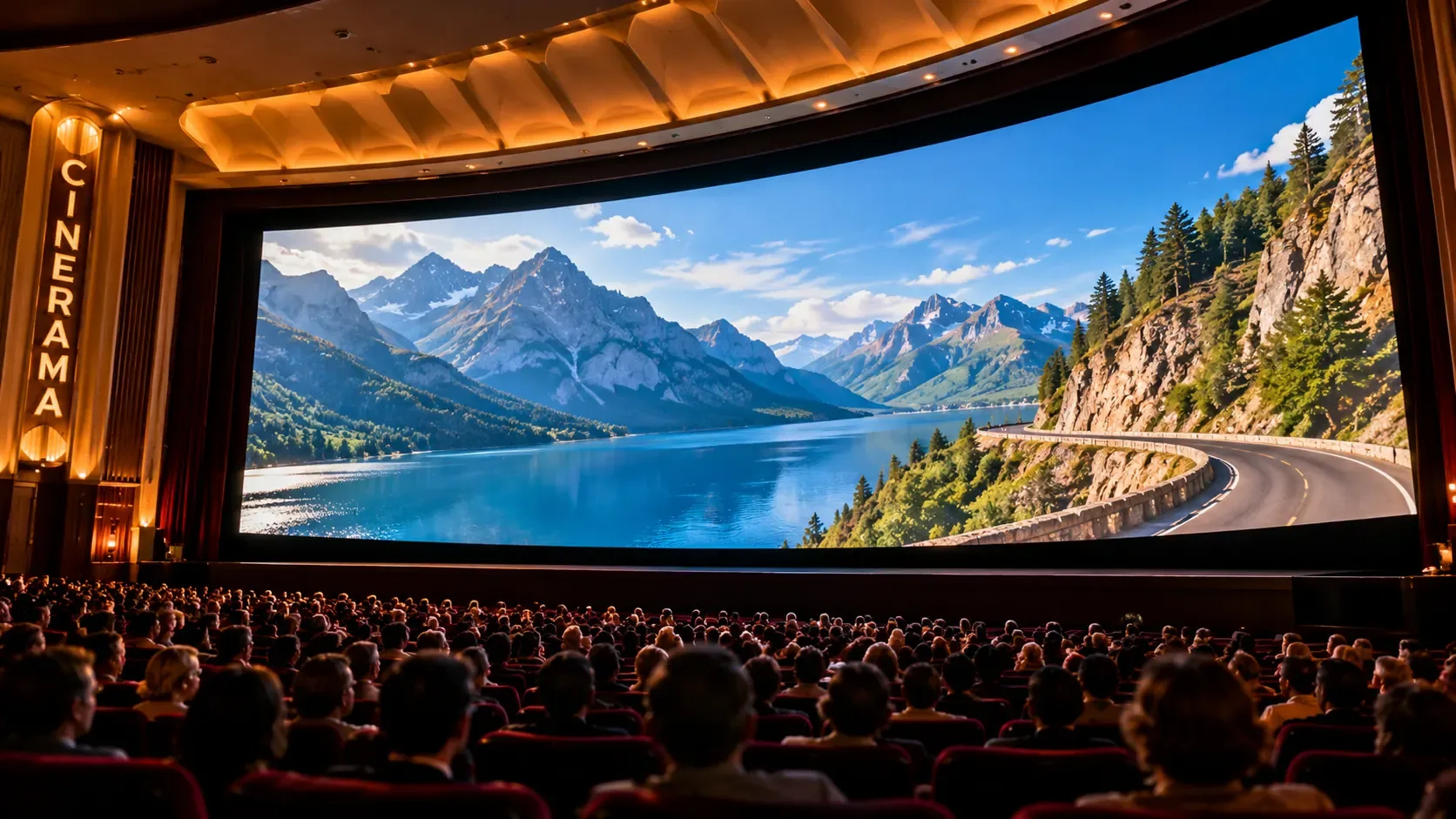 AI-generated illustration of an immersive curved-screen cinema experience; not a documentary photograph of the Cinerama Dome interior. |
The Opening Night That Made HistoryOn November 7, 1963, the Cinerama Dome opened with Stanley Kramer's comedy It's a Mad, Mad, Mad, Mad World. Its title practically required an extra-wide marquee. The film remained at the Dome for 66 weeks, establishing the theater as a destination for major releases. There is an intriguing twist: despite the theater's name and its famous curved screen, that opening film did not use the original three-projector Cinerama process. It was presented using a single-film wide-screen system. The Dome would not show a film in the original three-panel Cinerama format until its restoration era in 2002. |
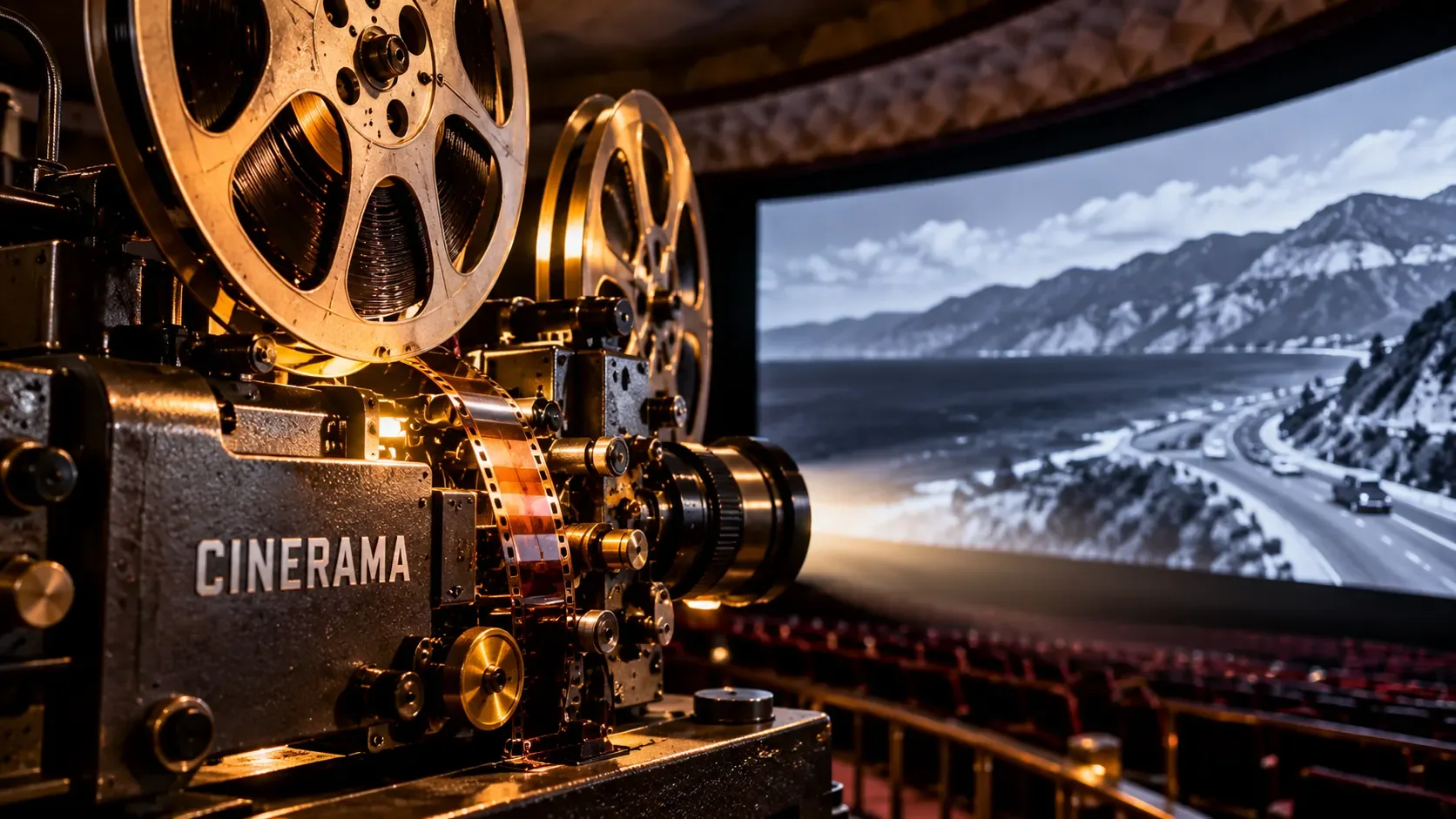 AI-generated illustration of vintage film projection equipment; not a photograph of the Cinerama Dome's actual projection booth. |
Why the Dome Became a Hollywood LandmarkThe Cinerama Dome was a movie theater, but it also made an architectural argument. Hollywood did not need to look backward to create a landmark. Its geometric roof, sweeping interior and dramatic screen belonged to a city fascinated by technology and spectacle. Becket's firm had also designed the Capitol Records building, another unmistakably modern Hollywood silhouette. One was a stack of curves reaching skyward; the other was a concrete constellation planted beside Sunset Boulevard. Both became part of the neighborhood's visual vocabulary. Why Is the Cinerama Dome Famous?The Cinerama Dome is famous for its striking geodesic concrete roof, enormous curved movie screen, 1963 opening premiere and status as a protected Hollywood landmark. The Battle to Save the Curved ScreenBy the late 1990s, the Dome faced a different sort of drama. A redevelopment proposal threatened major changes to its historic spaces and the character of its exterior. Preservation advocates, including the Los Angeles Conservancy, Hollywood Heritage and Friends of Cinerama, challenged plans that could have replaced the curved screen and diminished the building's street presence. Their campaign helped produce a 1998 agreement protecting important architectural features. The Dome also received Los Angeles Historic-Cultural Monument designation that year. The dispute was a reminder that a building does not have to be a century old to matter. Why Was the Cinerama Dome Threatened by Redevelopment?Late-1990s redevelopment plans threatened to alter its historic interior and exterior. Preservation advocates pushed back, helping secure protections for key features in 1998. |
A New Chapter for an Old-Fashioned Night at the MoviesIn 2002, the restored Dome became the centerpiece of the ArcLight cinema complex. Its enormous curved screen survived, and the theater continued to serve as a place where seeing a movie felt like an occasion. After the complex closed in 2021, the Dome's future again drew attention. Those reopening developments deserve their own news story; the history of the building is larger than any one operating schedule. Its place in Hollywood rests on what people fought to keep: a distinctive room built for watching stories together. Where Is the Cinerama Dome?The Cinerama Dome stands at 6360 Sunset Boulevard in Hollywood, near Vine Street. Its landmark exterior can be seen from the street, although interior access depends on the theater's operating status. Anyone planning a visit should confirm current access separately. The Shape of a Hollywood MemoryHollywood has always been willing to invent tomorrow and then grow sentimental about yesterday. The Cinerama Dome manages to do both at once. Its concrete triangles were once a daring glimpse of the future. Now they are part of the city's memory. The next time you pass that unmistakable roof on Sunset Boulevard, consider the wonderful oddity of it: a building designed to make movies feel bigger that became a story worth preserving all by itself. |
28 Comments
Join the conversation
The three-projector process is interesting, but I mostly want to know what a ticket cost in 1963.
I like that the design promised something different before you even got to your seat. That's a pretty good first impression.
Was the Dome built specifically for the three-projector system? The screen and building seem made for each other.
The corner near Vine is busy enough now. I can't imagine seeing that huge dome appear there for the first time.
I wonder what the first audiences said when they saw that wide Cinerama image. TV must have felt tiny afterward.
My favorite detail is that Hollywood went with geometric concrete instead of another grand entrance. It took some nerve.
A movie filling your peripheral vision sounds great until you're sitting too close. Did people ever complain about that?
The shell is cool, though I can understand people preferring the older theater style. It must have looked strange back then.
I've always liked seeing the Dome from Sunset, but I've never been inside. Is the screen as striking as the roof?
I can see why a giant curved screen would get people off the couch in 1963. I'd have bought a ticket.
That building is a good reminder that people once worried TV might replace the theater. Funny how familiar that sounds.
Keeping three images lined up across one screen must have taken real skill. I would love to see how they did it.
Was the original Cinerama picture made for that deep curve, or could you show regular movies on it too?
I like the concrete shape more than the fancy old theater look. Hollywood had enough gilded angels already.
My grandmother used to call it the spaceship theater. Now I see why.
I walk by that corner sometimes and never knew the Dome dated back to 1963. It held up pretty well.
The curved screen is the part I want to know more about. Did it change how movies were filmed?
The Dome always looks like it landed on Sunset by accident. I mean that in a good way.
I wish I could have seen a film there when the three-projector setup was new. Must have been wild.
Honestly, three projectors sounds like a headache. Was the picture noticeably better than a regular movie?
I get why theaters wanted something bigger than TV. A screen filling your side vision would do it.
The space-age look makes sense for 1963. I wonder who decided a movie theater should look like that.
Sunset near Vine has changed so much, but that concrete dome still catches my eye every time.
Did every seat have a good view of the curved screen? I always wonder about the seats way off to the side.
My dad talked about seeing movies on that curved screen. He said it felt like you were right there.
I love that the Dome looked different from the older Hollywood theaters. The shape makes it hard to miss.
Three projectors running in sync sounds like a lot of work. I wonder how often one got out of step.
That concrete shell still looks futuristic to me. Was it controversial when it went up in 1963?