
Beachwood Canyon: The Hollywood Neighborhood Built Like a Storybook |
How a 1923 hillside development gave Hollywood its stone gates, hidden stairs, storybook houses — and a world-famous sign. |
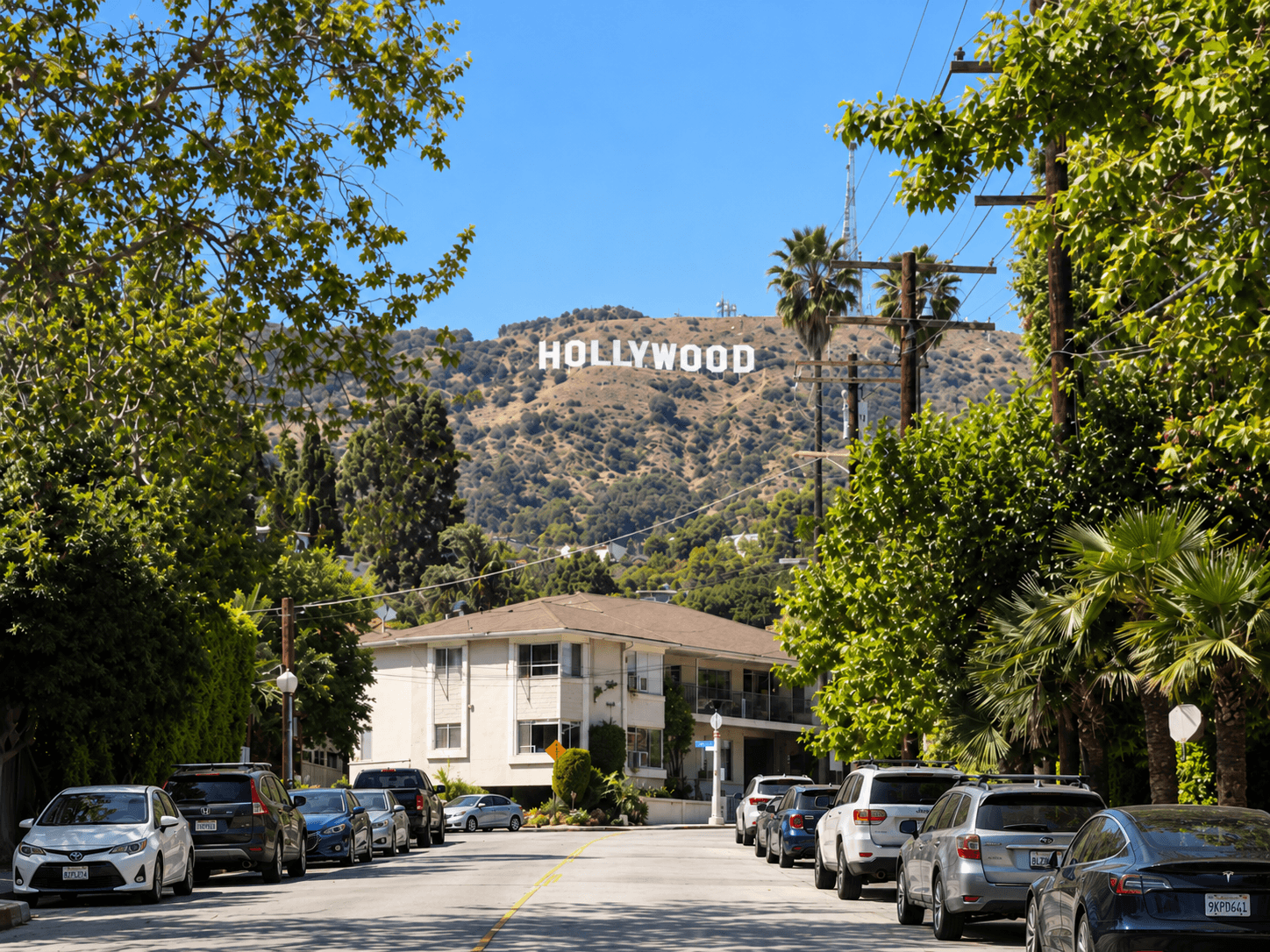
Hollywood has always been talented at making an entrance. But drive north from Franklin Avenue into Beachwood Canyon and the spectacle becomes quieter. The streets climb, the houses acquire steep roofs and unexpected towers, and a neighborhood begins to resemble a village somebody dreamed up for a film. The surprise is that this storybook setting was planned long before it became a familiar backdrop. Beachwood Canyon is a real residential community, not an outdoor set. Its unusual appearance comes from an ambitious 1920s development called Hollywoodland, whose stonework, staircases and architecture still shape the hillside. A Real-Estate Dream in the Hollywood HillsIn 1923, developers launched Hollywoodland in the upper reaches of Beachwood Canyon. The venture involved prominent Los Angeles business figures and developer Sidney H. Woodruff, who became its leading organizer after the death of partner Tracy Shoults. Their pitch was more than a collection of hillside lots: it was a carefully styled place where city life might feel a little farther away. A Los Angeles historic-preservation report describes a planned community inspired by European villages, with architectural rules governing early houses. French Norman, English Tudor, Mediterranean and Spanish Colonial Revival influences gave the streets a family resemblance without making every home identical. |
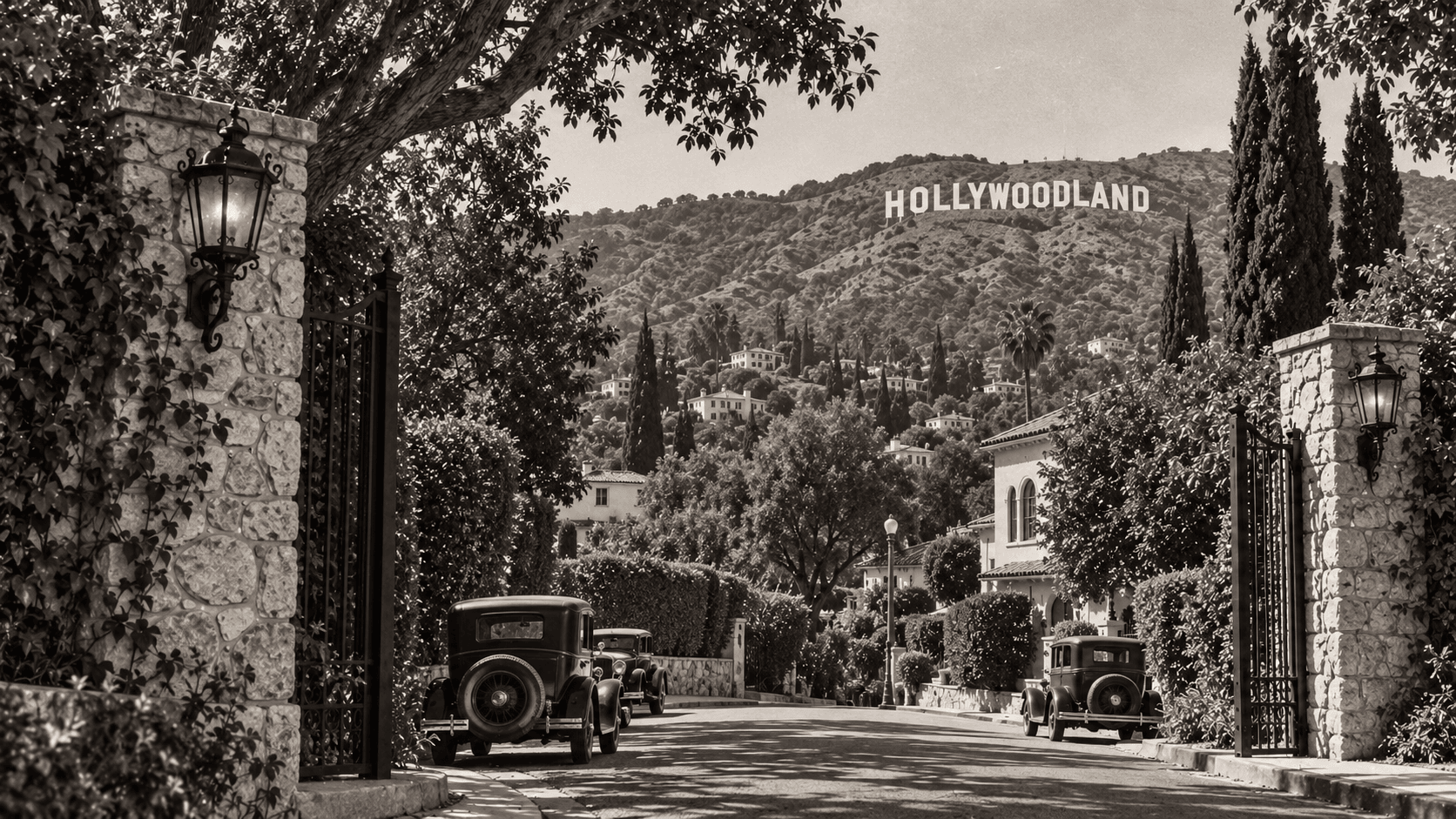 Original AI-generated black-and-white illustration imagining Hollywoodland in the 1920s, with vintage automobiles, stone entrance pillars, hillside houses, and the original HOLLYWOODLAND sign. Artistic interpretation only; not an authentic archival photograph or an accurate historical reconstruction. |
The developers also built roads, utilities, retaining walls, stairways and neighborhood amenities. In other words, the fantasy needed plenty of practical engineering to survive on a steep hillside. |
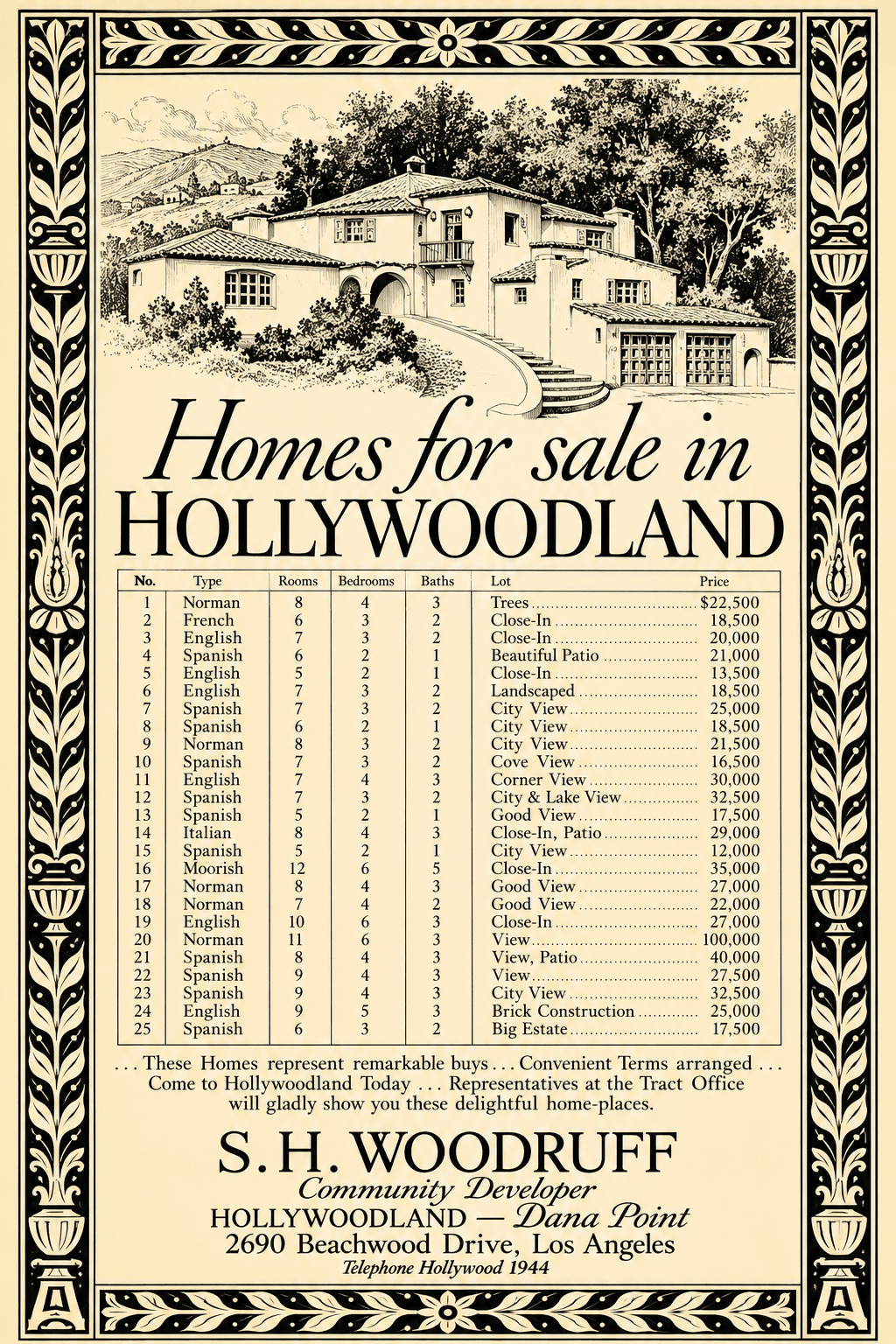 Original AI-generated recreation inspired by a 1920s Hollywoodland real-estate advertisement. Decorative layout, home listings, and prices are illustrative and should not be treated as a faithful reproduction or verified historical records. |
The Stone Gates That Announce Another HollywoodOne of Hollywoodland's most recognizable details is the pair of stone entrance gates on Beachwood Drive. They are not the gates to a theme park, although they certainly know how to make a first impression. European stonemasons helped create the granite features that give the neighborhood its distinctive character. Los Angeles designated the Hollywoodland stone gates Historic-Cultural Monument No. 20 in 1963. The granite retaining walls and historic stairways received their own landmark recognition later. These details help explain why the neighborhood feels so different from the broad boulevards below. Where Are the Hollywoodland Stone Gates?The historic entrance gates stand along North Beachwood Drive in upper Beachwood Canyon, near the neighborhood's small commercial village. They mark the transition into the original Hollywoodland development. This is an active residential street, so visitors should admire the gates without blocking traffic or private driveways. A Neighborhood Built for Walking — and ClimbingThe staircases are among Beachwood Canyon's most memorable surviving features. Built into the hillside to connect winding streets, they were both useful shortcuts and part of the original landscape design. Some have striking stone walls and unusually elaborate details for something as everyday as getting from one block to another. The stairs are historic public features, but they pass close to people's homes. The local neighborhood association asks visitors to respect residents' privacy and quiet. It is sensible advice anywhere; it matters especially on a narrow hillside street where a casual sightseeing stop can become somebody else's traffic problem. For a closer look at the steps and the streets around them, this walking video follows the historic Hollywoodland stairways. It offers a sense of their scale that photographs alone cannot quite capture. The winding route is a reminder that these stairs are woven into a residential neighborhood. Their history is worth exploring, and so is the courtesy owed to the people who live beside them. |
Are the Beachwood Canyon Stairs Historic?Yes. Hollywoodland's historic granite retaining walls and stairways are recognized together as Los Angeles Historic-Cultural Monument No. 535, designated in 1991. They are part of the neighborhood's original 1920s development rather than a modern tourist attraction. The Billboard That Outgrew Its AdvertisementThe most famous part of the original sales campaign was a giant sign on Mount Lee. When it first appeared in 1923, the letters spelled HOLLYWOODLAND, advertising the new subdivision below. The sign later lost its final four letters and became a symbol of Hollywood itself. It is a wonderful bit of Los Angeles irony: a temporary-looking real-estate promotion eventually became the city's most recognizable landmark, while the neighborhood it advertised remained a relatively quiet place of homes, stairways and winding roads. Why Did the Hollywood Sign Originally Say Hollywoodland?The sign was created in 1923 to promote the Hollywoodland residential development in Beachwood Canyon. It was a real-estate advertisement, not originally a tribute to the film industry. The shorter HOLLYWOOD name came later, as the sign's identity changed from neighborhood promotion to citywide icon. For a detailed account of that transformation, PBS SoCal's history of the original sign is especially useful. |
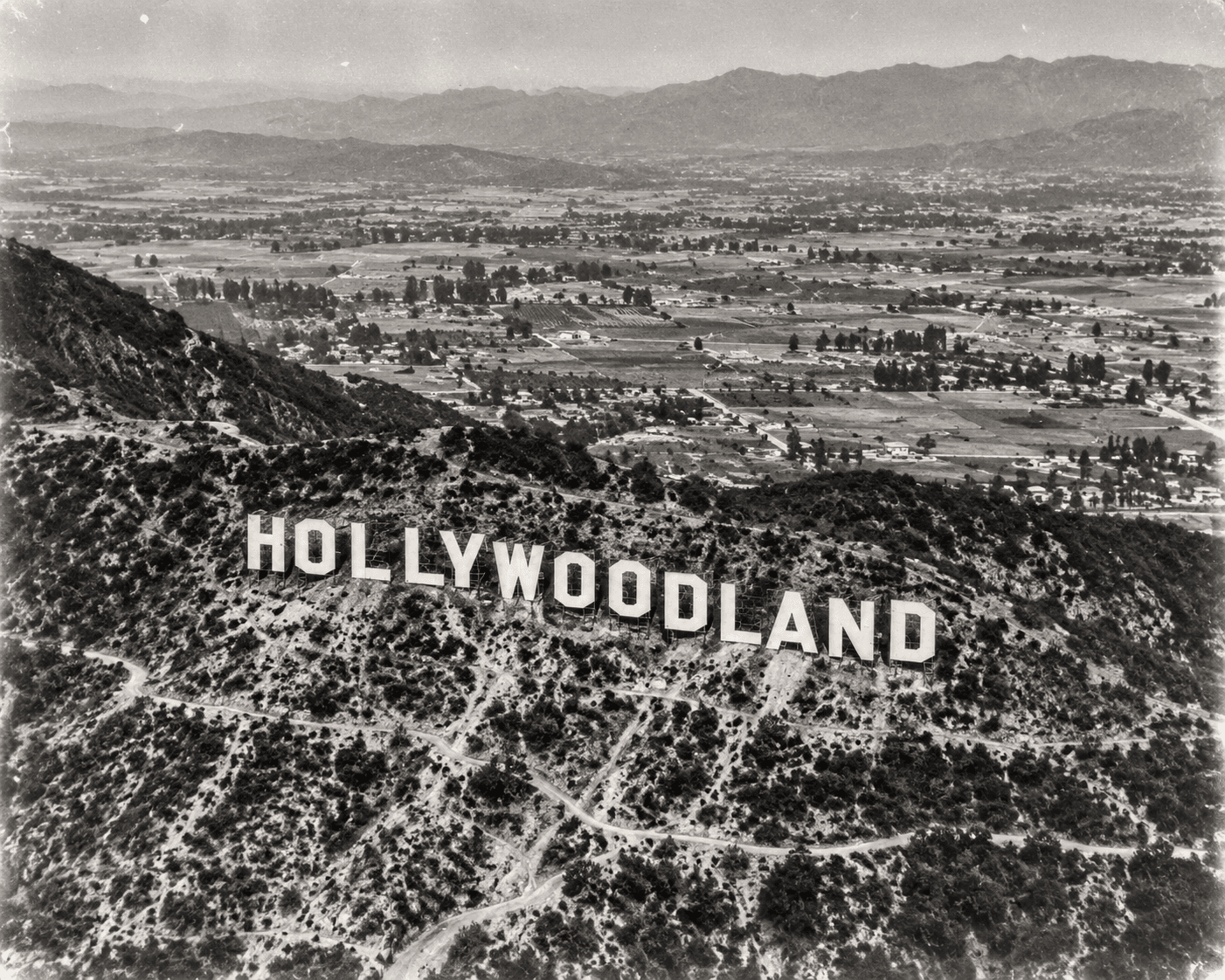 Original AI-generated illustration of the HOLLYWOODLAND sign above the Hollywood Hills, styled to resemble an early 20th-century black-and-white aerial photograph. Artistic interpretation only; not an authentic archival photograph or exact historical reconstruction. |
A Village With Neighbors, Not Just NostalgiaBeachwood Canyon's story did not end when the developers stopped selling lots. Its houses became homes, its small commercial area served daily needs, and generations of residents inherited a landscape that was both beautiful and complicated. The steep terrain that creates dramatic views also means narrow roads, limited parking and serious fire-safety concerns. That is why the neighborhood is best understood as a living community rather than a checklist of photo opportunities. Historic preservation and everyday life have to share the same winding streets. The Hollywoodland Homeowners Association describes the area's history and its environmental setting, while the Beachwood Canyon Neighborhood Association explains local preservation efforts. Is Beachwood Canyon the Same as Hollywoodland?Not exactly. Beachwood Canyon is the broader Hollywood Hills neighborhood. Hollywoodland is the historic planned subdivision in its upper portion, beyond the stone entrance gates. The names are often used together because the 1923 development left such a strong architectural imprint on the canyon. The Best Part of the Story Is That It Is Still HereThe old stonework, the climbing streets and the little village buildings remind us that Hollywood's history is not confined to theaters and studios. Sometimes it is hiding in the practical details of a neighborhood: a staircase, a retaining wall, a front gate that has been greeting people for a century. Beachwood Canyon was designed to feel a little removed from the city. The remarkable thing is how much of that feeling survives, even as the city around it has changed. It is Hollywood's storybook neighborhood, yes — but the most important word is still neighborhood. For a deeper historical record, see the Los Angeles City Planning historical analysis and the local historic-staircase overview. |
28 Comments
Join the conversation
I hope the old staircases and stonework are being maintained. They're such a big part of the canyon's character.
The 1923 date surprised me. I always assumed that village look came later with the movie industry.
I'd love a walking tour that explains the different house styles, as long as it respects the neighbors.
Those little towers are what I remember from visiting a friend up there. They make ordinary houses look grand.
I'm a little skeptical of calling the place an escape from city life. Hollywood was right down the hill.
Does the preservation report say which parts of Hollywoodland changed the most over time?
I like that the styles gave the streets a common look without making every house a copy.
That turn north from Franklin is one of my favorite drives. The stone walls make it feel older than the rest of Hollywood.
It's sad Tracy Shoults died before the project took shape. I'd be interested to know what his original plans were.
The storybook look is charming, though I bet maintaining one of those hillside houses is another story.
I never noticed how many different rooflines there are in Beachwood Canyon. Now I'll be looking up.
Are the architectural rules still in effect, or were they only for the first houses?
A planned escape from city life in the 1920s sounds pretty familiar. Some things don't change.
I'd like to know who built all that stonework. Hauling materials up those slopes couldn't have been easy.
My aunt lived near Beachwood years ago. I remember the staircases more than any of the houses.
The mix of Spanish Colonial and Tudor sounds odd on paper, but it somehow works on those streets.
I wonder if any of the first Hollywoodland homes still have their original interiors.
Driving up from Franklin Avenue, you really can feel the neighborhood change. The towers always catch my eye.
Sidney Woodruff is a name I hadn't heard before. Did he live in Hollywoodland himself?
I'm glad the piece says people live there. Those narrow hillside streets aren't made for a parade of sightseers.
It's funny how a real neighborhood can look more like a film set than some actual sets do.
Which houses are French Norman and which are English Tudor? I can never tell those styles apart.
I used to walk the Beachwood Canyon stairs with my dad. Never knew they were part of the original plan.
Calling it a village sounds nice, but I'd be curious how the people living there felt about all those design rules.
The stonework is my favorite part up there. It's easy to miss when you're watching the road.
I like that the early houses had rules but don't all look the same. I'd love to see what those rules actually said.
Those steep roofs really do make Beachwood Canyon feel like a little village. I always wondered if that was intentional.
I had no idea Hollywoodland was planned back in 1923. Are the original staircases still open to walk?